When the holidays come around, I can’t help it. Sometimes I get so stressed I just wanna kill somebody. (On paper, of course!) It can be very cathartic.
But if my murderous muse isn’t singing, I turn to my favorite holiday crime novel, Holiday in Death, by the supreme, futuristic murder writer, J.D. Robb. (It irks me that some industry aficionados refer to this series as “romantic suspense.” Sure, it has a romance in it, BUT, this is a crime novel in every sense!)
Holiday in Death is the seventh in the now fifty-one book series about New York murder cop Eve Dallas and her devastatingly rich, handsome and techno-wizard husband, Roarke. Did you catch that? There are fifty-one books in this series, with the next, Faithless in Death, coming February 9, 2021.
But I digress. Here’s the scoop on my favorite Christmas mystery taken from its Publisher’s Weekly review 6/01/1998.
The year is 2058. Guns are banned and medical science has learned how to prolong life to well beyond the century mark. And man has yet to stop killing man. At Cop Central, it’s Lieutenant Eve Dallas’s job to stand up for the dead. So begins the seventh riveting installment in Robb’s (aka Nora Roberts) futuristic romantic suspense series (following Vengeance in Death). With Christmas only weeks away, Eve is stressing out trying to find the right gift for her new husband, Rourke, who “”not only had everything, but owned most of the plants and factories that made it.”” More to her concern is the latest serial killer who is using “”The Twelve Days of Christmas”” as a theme for his heinous rape and murder spree. The case touches Eve on a personal level, and while flash-backs from her abusive childhood are flinchingly repetitious, it defines Eve’s gritty, hard-boiled character and validates her obsessive determination to bring down the killer any way she can.
So if the holidays stress you out, grab a peppermint-schnapps-laced, hot chocolate, get in that comfy chair in front of the fireplace, turn on that Tiffany lamp that casts just enough light for you to read by, settle your animal on your lap, and crack open this great read.
Merry Christmas, everyone!
P.S. There is one story I like better at this time of year, just for the record. You’ll find it in the Bible’s new Testament. I usually start at Luke, chapter one.
“Long before I wrote stories, I listened for stories. Listening for them is something more acute than listening to them. I suppose it’s an early form of participation in what goes on. Listening children know stories are there. When their elders sit and begin, children are just waiting and hoping for one to come out, like a mouse from its hole.” – Eudora Welty, One Writer’s Beginnings
In 2000, I wrote a story I titled, “Stop Signs.”
That was in the Dark Ages. Ancient desktop, probably Windows 3.1 and WordPerfect. Hard drives. Floppy disks that didn’t flop.
I composed in cursive—sat on the bed with a pencil and a tablet, wrote a couple of pages, crossed the room to type the fragment into a document and make some edits, moved back to the bed to pencil two or three more pages, went back to the computer to transcribe and edit, moved back to the bed . . . And reaching “The End,” printed and penciled in more edits, then went back to the keyboard to type the changes, then printed and penciled more edits, then back to the keyboard . . .
It was my second foray into fiction. I rather liked the result, and as a naive newbie, I submitted it to a contest. A month later the North Texas Professional Writers Association notified me the story had placed first in its fiction division. They enclosed a check for $50 (real money!) and a copy of the chapbook in which winners’ work was published.
Later I became comfortable composing at the keyboard. I printed, marked the manuscript, revised and edited the document, went through that process several times, stored the file, ripped up the paper.
Down the road apiece, “hard copies” became unnecessary—just attach a file and email it off to contests or zines. Easy peasy.
And then came another desktop, and laptops, and new versions of Windows, one after the other, and CD-ROMS (writable!), and external backups, and online backup services, and cloud backups, and a whole raft of things I’ve never heard of.
The paperless society. Everything on record, available at the touch of a fingertip, no document or image ever lost.
Yeah, right.
First, a flash drive disappeared. Several years later, during one of my 3:00 a.m. housecleaning binges, I moved the refrigerator and found it lying beneath, stashed there by a cat with her own method of digital storage. But it was no big deal; most of the documents were safe on the hard drive.
Then there was the crash. I’d been thinking about subscribing to an online backup service but just hadn’t gotten around to it. Still, no big deal. I’d hidden all the flash drives from the cat. And, quite frankly, there were a few files I was relieved to lose.
But last week I realized I’d lost something that matters: “Stop Signs.” My award-winning story. The first story that I was paid for. In money.
But more important than awards or money—my words were missing.
The file isn’t on my hard drive. Or in the cloud. Or in Drop Box. And I can’t find the chapbook.
Oh, it isn’t really lost. The chapbook is here. Somewhere. When we moved last year, I packed it. I just don’t know where it landed. Saturday, I went hunting.
I didn’t find it. I found something better: a draft of an interview I did in the early 1980s with my Great-aunt Bettie Pittman Waller, who was married to my grandfather’s older brother Maurice. It’s a mess, pages unnumbered–it was typed on a typewriter, probably directly from the cassette tape–with scribbled directions for moving this paragraph here and that paragraph there, to make it into a coherent whole.
Aunt Bettie and Uncle Maurice grew up in the Cottonwood Community in Guadalupe County, across the San Marcos River from the town of Fentress, Texas, where they lived for most of the nearly sixty-five years they were married. They were pillars of both Presbyterian and Methodist Churches—in the back pew of the Methodist Church on first and third Sundays, the back pew of the Presbyterian on second and fourth. What other people did was none of their business. They didn’t judge. They also didn’t sit down front because Uncle Maurice had no intention of being noticed and possibly asked to take up collection.
When they married, all she knew how to cook was pancakes. Three months later, Uncle Maurice told her she was simply going to have to learn to make something else.
She was born in 1886 and died in 1987; for most of that time, her mind was sharp and her memory impeccable. She moved from Cottonwood to Fentress in 1901, was the youngest resident, when her widowed mother built a boarding house there. She remembered names and dates. She held the history of the town.
She told stories about their marriage and the town and the people, and Uncle Maurice, who was known for not talking, sat there shaking with silent laughter. There was so much to laugh about.
Why does all this matter? Because I was a listening child. Because my roots are deep in the town she was so much a part of. A small, insignificant place, except to the few who remember.
Because that’s where my imagination lives.
Because my work in progress is set in a little town named Cottonwood, whose history is very like that of the small, insignificant place.
Frank Waller with catfish. He believed stop signs cause wrecks.
Because “Stop Signs” begins, My grandfather thinks stop signs cause wrecks—a statement my grandfather made while I was listening.
Because history isn’t a list of presidents and kings, wars and laws and dates. It’s ordinary people, who they were, what they did, day after ordinary day.
And because those ordinary people and places should not be forgotten.
###
The following is an excerpt of the interview with Aunt Bettie–her first date with Uncle Maurice, and two events that happened early in their marriage, while they were still living on the farm. “Pat” was Uncle Maurice’s pet name for Aunt Bettie. Barney and Frank are Uncle Maurice’s brothers. Tishie is Aunt Bettie’s older sister, Letitia. Old Fritz is a horse.
******
Maurice and I married in 1905. I remember our first date; we didn’t know the word “date,” we called it “having company.”
Bettie Pittman and Maurice Waller. Wedding picture, 1905.
Mama wouldn’t let me go with boys. That was my sixteenth birthday, and I slipped off to go. I wasn’t proud of it, bit I did.
Ollie Hudgens was my best friend and Maurice’s cousin, and Pent Gregg was Maurice’s best friend and my cousin. Mr. Hudgens didn’t like Pent, but Ollie went with him anyway. Ollie was going to spend the night with me on my birthday, and Pent was going out with Ollie, and he didn’t want me along, so he made Maurice go along, too. I left home with Pent and Ollie, and later Maurice caught up with us. He had borrowed a buggy.
We were going to a protracted meeting at the Baptist Church at Prairie Lea. It was very dusty, the 19th of June, and watermelons were in. The 19th was always the biggest part of the melon season. Maurice had access to the icebox at the [family] store, and he put a melon in for us to eat after church.
Maurice had never had a date either, and we didn’t know what to say. Going down, I said, “It’s sure dusty, isn’t it?” and he said, “Surely is.” That’s all we said all the way to Prairie Lea. But on the way home, we got better acquainted.
It was the brightest moonlight I ever saw. We had to cross the river, and there was a gravel bar there. When we got home, Maurice got the melon, and it was cold and nice, and we four went down on the gravel bar and ate the melon. We had such a nice time. I called it my sixteenth birthday party—it was the first party I’d ever had.
But then I couldn’t get Mama to let me go out again. I cried and begged Mama to let me go. Tishie had a different way with Mama—she got mad and talked back, and then she didn’t get to go anywhere either. But I knew better.
So I had to slip around to see Maurice. I wasn’t proud, but that was the only way I could see him.
###
To Maurice, this was the funniest thing that ever happened. Ward Lane got muddy when it rained much. If you kept in the ruts, you did all right and didn’t stick. But it wasn’t wide enough for two to pass. You could probably squeeze by if it was dry, but not if there was mud.
There was a show in Fentress that night—we lived on the farm that year—and we went early, before dark. On the way home, about ten o’clock, it was bright moonlight. We had to go very slow because it was so muddy.
Our buggy didn’t have a top—it was a trap, a popular kind for youngsters then. I don’t know whose it was; well, I guess it was ours, because we were married then. Before we married, Maurice shared a buggy, but Frank didn’t go out with girls till he started going with Vida, so he didn’t need it much.
That night Maurice didn’t hold to the reins tight. The wheel hub on his side hit a fence post and knocked the car around. I fell perfectly flat on my back in the mudhole. It was so bright you could see very well.
I said, “Oh, I’m killed!”
Maurice didn’t say anything, and then I realized he was laughing as hard as he could. I thought, He doesn’t care if I am killed. That crossed my mind.
When he finally could talk, he said, “I’m just getting even with you.”
I wasn’t fit to get back in the buggy; I sat on the edge of the seat all the way home. I was wearing a white linen dress I had made, and I thought it was so pretty, and that stain never did come out. Boiling didn’t take it out. It was a fine woven cloth, and it was ruined.
But Maurice had a lot of fun out of it. Whenever it was mentioned, he would say, “Well, I just got even—I always wanted to.”
###
What he was getting even for happened soon after Barney and Hallie married. Maurice and I had been married a while, but I wasn’t a housewife, and I didn’t know anything about entertaining. It was Sunday morning, very cold, and we had a fire in one room, the only room where we could have a fire. Maurice was taking a bath in there, just inside the kitchen door to the dining room.
We heard a knock at the door, and I went to answer it, and Maurice said, “Pat, don’t ask them in here.”
But it was Barney and Hallie—he had come to introduce his new wife to us—and I didn’t know what else to do, so I said, “Won’t you come in?”
When we got into the kitchen, Maurice had disappeared.
Maurice and Bettie Pittman Waller, ca. 1940s.
Well, I was so tickled that I know Barn and Hallie thought something was wrong with me. They sat down and we visited and in a minute Barney said, “Bettie, when we drove around back, old Fritz had his head in the crib and was eating corn.” We had just a little corn out there to feed him, so I was going out to shut the door, even if it was cold.
When I passed through the dining room, there was Maurice, plastered up against the wall, wet and without a stitch on, just freezing to death. He said, “Bettie, get me some clothes.”
I just walked out and laid my head up against the corn crib and laughed till I cried.
Maurice was furious; that was the first time he’d got mad at me like that.
He never did get over it till he knocked me in the mud.
In the northern hemisphere, the winter solstice, December 21, 2020, will happen at the same instant for all of us, ushering in the longest night of the year. Therefore, it is appropriate that December celebrates so many festivals and religious holidays, using lights and candles in their traditions to illuminate the darkness. Depending on where one looks, there are many festivals in various cultures. Still, the three most recognized December celebrations in North America are Kwanzaa, Hannakuh, and Christmas. Each of them lights the cold, dark days of December with warmth, love, unity, family, and spirituality.
Kwanzaa was introduced in 1966 by Dr. Maulana Karenga for African-Americans. This holiday’s seven principles are self-determination, collective work, responsibility, unity, cooperative economics, purpose, creativity, and faith. Candles are lit to represent each of these principles, and gifts are exchanged on December 31, with banquets of food, often from various African countries. May peace, love, and unity bring a happy Kwanzaa to all and blessings on your families.
The oldest of these three holidays is the eight-day celebration of Hannukah, the Festival of Lights. It will begin on December 10 and end on December 18, commemorating the rededication in Jerusalem of the second Temple, which was fought for and won back from Greek-Syrian oppressors. Historically, Israel’s land fell to Antiochus III, the Seleucid king of Syria. He permitted the Jews to continue practicing their religion, but his son Antiochus IV was not as benevolent. He ordered Jews to worship the Greek gods, and when they resisted, Antiochus IV massacred thousands of them and desecrated the city’s holy Second Temple by building an altar to Zeus, upon which they sacrificed pigs.
According to the Talmud, it was the Maccabee Revolt, in 168 B.C. that won back the temple. Following a three-year war and eventual victory, they cleaned the Temple, destroyed the defiled altar, and built a new one. When the Maccabees held the rededication celebration and rekindled the menorah, they found they only had and enough untainted oil to light the menorah for one night. Miraculously, the flickering flames continued to burn for eight nights, giving them enough time to find a fresh supply.
There are other interpretations of the Hannukah story. Still, no matter which one a person ascribes to, Hannukah is celebrated for eight nights, with ritual blessings recited upon lighting each candle of the prominently displayed menorah. There are particular foods prepared to celebrate the Hannukah tradition including potato latkes and jam-filled donuts, and children delight in playing with the four-sided spinning tops called Dreidels—Chag Hannukah Sameach or Happy Hannukah to all, and blessings on your families.
Jewish historian, Josephus, wrote that after Herod Archelaus, a Roman client king, converted his territory, Judea, into a Roman province, Publius Sulpicius Quirinius, the newly-appointed governor, was assigned to carry out a tax census.
According to Christian scripture, Joseph and his wife, Maryam, devout Jews, went from Nazareth in Galilee to Judea, to the city of David called Bethlehem, because Joseph was descended from the house of David. When they arrived, Maryam began her labor and there was no room for them at the inns. Without lodgings, they found shelter in a nearby cave, which was also a stable, and there Jesus was born. Mary placed her sleeping baby in an animal trough filled with clean hay.
Out in the cold, dark night, in the countryside near Bethlehem, angels appeared and announced the good news to the shepherds, watching their flocks. The Messiah had been born. The shepherds listened to the angels and found the baby Jesus, sleeping in the manger in Bethlehem.
Traveling for days, following a brilliant star shining over the stable where Jesus was born, the Magi, Melchior, Gaspar, and Balthasar came from distant eastern countries, arriving days later with gifts for the newborn king. Gold to honor his kingship, Frankincense to recognize his deity, and Myrrh a particular anointing oil.
Over centuries, the gift-giving ritual commemorating the gifts brought by the three wise men devolved into a fully commercialized event. It pays less attention to the significance of Christ’s birth but is still a celebration of light and joy. Whether celebrating Christmas as a gift-giving holiday tradition or commemorating it as the birth of Jesus, it is a time of joy, hope, and love.
And so, the dark days and long nights of December are lit by traditions and celebrations of light, love, and the blessings of family and friends.
Happy Kwanzaa, Happy Hannukah, and Happy Christmas!
Try to imagine a mystery without its setting. What? You’re having trouble?
Open a mystery and be denied the setting. What? You’re getting irritated? Why?
We use our senses to smell, to see, to hear, to feel a setting. We LIVE in our own settings, with their dimensions of sight, smell, sound, touch, with plants to see and smell and touch, other humans to love or fear. We use all our senses to apprehend a setting, and we imagine with those senses when we engage in a mystery setting. A mystery without a setting? Our imaginations would feel so deprived.
And if we’re talking about a “regional” mystery without a setting—what’s the point? I read about Venice because I want to feel I’m there as well as follow Guido Brunetti around his favorite canals. If it’s one of Spencer Quinn’s Chet and Bernie mysteries I want to ride with Bernie in his beat-up Porsche, with Chet in the front seat (his tongue hanging out of course), cruising through the Arizona desert.
Texas mysteries? Local color, please. Note that term “color,” that appeal to our senses! The color of eyes and landscapes, the sound of accents and music, the feel of dry wind or thunderstorms, the scent of salsa and barbecue, saddles and blankets, cedar and limestone, creek water and cypress trees. We want it all.
We mystery writers face so many decisions. Protagonist? Characters? Point(s) of view? Tenses? Oh yeah, the plot? But perhaps paramount? Setting.
At last year’s Bouchercon conference in Dallas, Elizabeth George told a rapt audience (including me) that in her Lynley series she begins with the setting. She described visiting various settings and how the characters emerged in her imagination—from the place.
Alexander McCall Smith agrees that in his novels, location is as important as the characters. “Place is often terribly important to us,” he said. “And to describe it is to describe our feelings for the world.” Our feelings for the world! Or at least, for the world of that setting.
Smith describes how he begins a book: “I mentally write the first paragraph and, on occasion, the last paragraph. With these two elements in place, all that remains is to write the bits in-between. The first sentence is very important. For me, that can set the whole tone of the book, and once I have the first sentence the task of writing proves relatively easy.”
“Precious Ramotswe, founder of the No. 1 Ladies’ Detective Agency, doyenne of private investigators in Botswana (not that there were any others, apart from her assistant, Grace Makutsi), wife of Mr. J.L.B. Matekoni (garagiste and past chairman of the Botswana Motor Trades Association, citizen of Botswana)—that same Precious Ramotswe was sitting in the second row of chairs at the open-air wedding of Mr. Seemo Outule to Ms. Thato Kgwadi.”
The paragraph continues: “It was a hot day in October, a month of heat and unremitting thirst for the land and all that lived upon the land: the cattle, the wild animals, the small, almost invisible creatures that conducted their lives in the undergrowth or among the rocks, creatures whose very names had been forgotten now. They were all waiting for the rains…”
We know we’re in Botswana at an open-air wedding where we’ve learned of the sleuth, her partner, and her husband, but the rest of the paragraph tells us even more: it’s hot and dry October, a time of “unremitting thirst for the land and all that lived upon the land: the cattle, the wild animals, the small, almost invisible creatures that conducted their lives in the undergrowth or among the rocks…”
We’ve felt how the protagonist, Precious Ramotswe, lives and breathes awareness of her country, where all creatures—human and otherwise, even the invisible creatures whose names have been forgotten—are waiting for the rains. What an appeal to imagination! Maybe this setting has extra appeal for readers in central Texas who know all too well the unforgiving heat of August, its crunchy dry grass, cracks in the soil, and desperate deer, waiting for a rousing thunderstorm to refill dry water tanks and refresh even the “small, almost invisible creatures” that surround us.
So a mystery setting is much more than a GPS setting. Accuracy’s important, as Rhys Bowen emphasized in her presentation to HOTXSINC (Heart of Texas Sisters in Crime): the writer risks losing all credibility with mistakes in location or description. But the mystery setting must include how the characters feel about the setting—which reveals more about the characters.
Here’s the beginning of Josephine Tey’s To Love and Be Wise (copyright 1951; Scribner Paperback Fiction 1998), with her series protagonist, Alan Grant of Scotland Yard:
“Grant paused with his foot on the lowest step, and listened to the shrieking from the floor above. As well as the shrieks there was a dull continuous roar; an elemental sound, like a forest fire or a river in spate. As his reluctant legs bore him upwards he arrived at the inevitable deduction: the party was being a success.
“He was not going to the party. Literary sherry parties, even distinguished ones, were not Grant’s cup of tea. He was going to collect Marta Hallard and take her out to dinner…The roar of the party’s success came flooding out through the open doors on to the landing, and Grant paused to look at the yelling crowd asparagus-packed into the long Georgian room and to wonder how he was going to pry Marta out of it.”
Ever felt like that, dear reader? Ever dreaded having to walk into a “roaring success” of a party with a “yelling crowd asparagus-packed”? I’m betting most of us (with our share of introversion) have “reluctant legs” in such situations. On Tey’s first page we learn Grant’s a “presentable escort,” a Detective Inspector at Scotland Yard, and can “afford to dine at Laurent’s.” But his “reluctant legs” indicate how this privileged character feels about even a “distinguished” literary sherry party. By dropping us into this particular London setting Tey helps us identify with her protagonist by his reaction to that setting. We walk with his “reluctant legs” up those steps. We understand that he (probably like us) is there because he feels an obligation, and, despite his feelings, he’s a man who meets his obligations.
Texas writer Tex Thompson pointed out in her recent presentation to HOTXSINC that one way to dial up the conflict in our mysteries is to dial up the contrast between the character and the setting. For example, is the protagonist a fish out of water? In my Ghost Cat, the protagonist Alice practices law in a small Texas town but fears any firearm other than a flare gun and feels like a complete impostor on a horse.
One engaging archeological mystery dive is Elly Griffiths’ Ruth Galloway Series set on the marshes of Norfolk, England. Ruth, a forensic archeologist, is often called to help local police when bones are found at construction sites. She feels many disconnects—unmarried mother of a daughter, slightly overweight, harassed by her university department head––but takes pride in her competence as a sharp-eyed and professional archeologist. She lives on a lonely road by the coastal saltmarsh, where water meets land, a liminal area with Bronze Age artifacts buried deep. Her love for this location drives the plot and enriches her character:
“Her favourite place. Beyond her front garden with its windblown grass and broken blue fence there is nothingness. Just miles and miles of marshland, sported with stunted gorsebushes and criss-crossed with small, treacherous streams…Ruth has absolutely no idea why she loves it so much.”
I wonder if archeology offers a challenge to our own imaginations. Just north of Austin is an archeological site including the “Gault Assemblage.” Very careful long-term excavation and documentation of the site now reveal human occupancy up to 20,000 years ago—much earlier than traditionally thought. The dates for human habitation in North and South America keep moving further and further back. And why wouldn’t early people have chosen this area? It’s on water…there’s chert available to chip into powerful tools…the nearby plains furnished buffalo. Similarly, recent breakthroughs in dating Neanderthal tools have pushed back dates for their culture by several hundred thousand years. Most artifacts of that age are lithic (rock points, rock knapping), and it takes sustained imagination and examination to understand what our ancestors were up to. It takes human imagination, staring at a biface point, looking at a reassembled cobble, to see the chipping techniques our ancestors developed, to begin to grasp the complex reality of their daily lives—their setting. Rebecca Wragg Sykes,Kindred: Neanderthal Life, Love, Death and Art.
In a way mystery-writing is archeological. In our imaginations we excavate clues from the past—perhaps an imagined past—to recreate what happened, or could have happened. We recreate in our imaginations what our characters saw, smelled, heard, felt…and did. Maybe the more richly we imagine the setting, the more the characters can come alive.
Okay, trowels up. Back to the trenches. Well, not archeological—but fingers on keyboards, pens on paper.
***
Helen Currie Foster is author of the Alice MacDonald Greer mystery series, her latest, Ghost Cat, was published in April 2020. She is also author of TheBloody Bead, a Bullet Book Speed Read, co-written with Manning Wolfe.
As writers, we often contend with voices inside our heads.
It’s not just me, is it?
As much as I love these characters who demand to be heard, there are moments when I need a break. I need someone else’s voice inside my head. Someone to inspire me or to teach me something interesting that could also prove useful in a future scene or novel.
I enjoy listening to other creatives discuss their process. I think, early on in my writing career, I hoped to glean that ONE RIGHT WAY to outline/plot/write a novel, but after so many years, I have come to learn that there is no single right way. And that each book may be different. A process that worked for one book no longer seems to bring results on the next project. Still, there’s something inspiring and interesting about listening to others talk about how they take their ideas and turn them into a story, how they wrestle with the demands of work/family/life obligations while working on a project. So, when I want to remain in the creative space but need a little distance from my own work, I turn to others to better understand how they manage their creative lives.
Here are a few of my favorites:
(Night Vale Presents) Start With This(Podcast): This podcast, from the creators of Welcome to Night Vale, tackle all aspects of writing from dialogue and pacing to creative crises and dealing with feedback. Each episode is in the half hour range, perfect for a listen as you walk your dog or work around the house. If you’re struggling with some aspect of your writing, take a break and tune in. It might be just what you need to get back on track.
Comedians in Cars Getting Coffee (Netflix): Jerry Seinfeld is known for his intense discipline to the craft of writing, for the daily dedication he still has in improving his skill at one-man storytelling, even though his Seinfeld show fame means he would never need to work again. This passion for creating and writing is on full display as he interviews other comedians to discuss all aspects of storytelling, writing and entertaining an audience. It’s a quirky show that speaks to my quirky heart. And the episode with Mel Brooks is pure gold.
Ten Minute Writers Workshop (NPR Podcast): Although this podcast wrapped last year, there are sixty ten-minute episodes with writers such as Louise Penny, Ian Rankin, Tana French, and Tom Perrotta. This remains one of my favorite podcasts because Virginia Prescott gives us a peak into the habits of some of today’s most talented writers, and her interview format is designed to help other writers in their own pursuits.
Here’s the Thing (NPR Podcast): Alex Baldwin’s personal antics can be up for debate, but you can’t argue with the man’s interviewing skills. This one surprised me in all the best ways. He’s interviewed everyone from Billy Joel and Carly Simon to Cameron Crowe and Kyle MacLachlan. Alec’s questions dig down deep into the topic of the creation of art of all kinds and how those pursuits impact personal relationships. For those who want to listen to the inside-baseball elements of writing, acting, and other creative endeavors, this public radio podcast pulls strong.
I recently appeared on a “Writing Humor in Mysteries” panel at the Pflugerville, Texas, Library along with fellow authors Kelly Cochran and Nancy West. My first reaction was the old adage, “Dying is easy, comedy is hard.” Unless you’re talking about the Pink Panther and Inspector Clouseau, one doesn’t usually think that humor and death work well as a pair.
Although the mysteries I write are serious, I find that interjecting comedy into the either the character or plot (or both) really moves the action along. It picks up the pacing, gives more depth to characters, and sometimes you just have to lighten the moment for the reader as the plot turns darker and darker.
I once read a blog by Zia Westfield (www.ziawestfield.com) and she outlined five elements that often appear in comedic mysteries.
The Screwball Heroine (think “I Love Lucy”)
The Wacky Secondary Character (obviously Ethel Mertz comes to mind)
The Snowball Effect (Events become more and more out of control)
Whatever Can Go Wrong, Make it a Hundred Times Worse (back to Lucille Ball)
Snappy Dialogue and Word Choice (Here pacing is everything)
In more serious murder mysteries, however, to me its all about the characters. For example, its possible to have a series of homicides and a very serious detective, but a side character can provide the comedic relief. In The Preacher’s First Murder, an elderly woman has gone missing and is considered to be in danger. Very scary stuff for the family. Enter an idiot rookie “hunter” who didn’t know a rifle from a shotgun. His exploits provided the needed chuckle to break up the intense drama.
I’ve also found that putting my hero in a foreign place presents lots of opportunity for the hero’s inner dialogue to ponder this “new world.” Again, in The Preacher’s First Murder, the hero, originally from Miami, has moved to small town Texas. The first time someone says “She makes a hornet look cuddly” he realizes he’s not in…well, you know.
For me, the easiest way to write humor is in first person, and I’ve found it to be a lot of fun. Most stories come from experiences I’ve had, a belly laugh all over. “Write What You Know”, as they say. Perhaps it goes without saying but I’ll say it anyway. It really helps to write humorous mysteries if you have a sense of humor yourself. Odds are that what makes you laugh will make others laugh too.
All Hallows Eve approaches, and it’s not just the children who love this holiday, with its ghost stories and the trick-or-treat traditions. According to the National Retail Federation, “more than 148 million U.S. adults plan to participate in Halloween-related activities,” [[i]] despite the restrictions of COVID-19! What is it that we love so much about Halloween?
According to a Purdue University professor, Halloween lets us experience a good scare without being in real danger. It is within human nature to seek out and suffer unpleasant feelings – but in small doses, allowing us to flirt with danger and experience the emotional rush— free of real consequences.[[ii]]
Historically, Halloween is believed to have originated with the pagan Celtic festival of Samhain. This ancient community, which lived 2,000 years ago, celebrated their new year on November 1 and believed that the boundary between the worlds of the living and the dead collided.
On October 31, the Celts believed the spirits of the dead returned to earth to cause trouble and damage their crops. They built huge sacred bonfires, where they burned crops and sacrificed animals to the Celtic deities. During the celebration, the Celts wore costumes, typically consisting of animal heads and skins, and attempted to tell each other’s fortunes. Before the festivities began, they extinguished their hearth fires at home. When the celebration was over, they re-lit them with flames from the sacred, ceremonial bonfire to help protect themselves during the coming winter.
By the ninth century, Christianity had spread into Celtic lands and blended Christian ceremonies with older pagan rites. In 1,000 A.D., the Catholic church designated November 1 as All Saints’ Day, or All-hallows/All-hallowmas (from Middle English Alholowmesse meaning All Saints’ Day), absorbing the Celtic traditions of Samhain, with bonfires and masquerades. This became All-Hallows Eve, and the word eventually compressed into Halloween.[[iii]]During this time, new rituals sprang up and were theforerunners to trick-or-treat, a custom not loved universally by parents in today’s world.
In Medieval England, on All Hallows Eve, poor people would visit the homes of wealthy families to receive soul cakes. The custom was called souling because “Little pastries were given in exchange for a promise to pray for the souls of the dead relatives.” [[iv]] In Scotland and Ireland, young people disguised themselves by dressing in costume, and accepting offerings from households in return for singing, reciting poetry, telling jokes, or performing a trick before receiving their treat.[[v]]
In the U.S., the custom of trick-or-treating became a staple of the American Halloween celebrations after WW II, when sugar rationing ended. In 1952, Walt Disney released the first Trick-or-Treat cartoon movie, starring Donald Duck, which helped solidify Halloween’s celebration in American culture.
Whatever one feels about the practice of trick-or-treating, there is another tradition that almost everyone looks forward to. Halloween is a fine time to revisit our beloved and deliciously scary, creepy stories and find new ones. Who can resist the urge to vicariously experience, without consequence, the chills, thrills, and fright of ghost stories and strange happenings?
Among thousands of spooky tales are Edith Wharton’s Ghost Stories, ranging from the unnerving appearance of ghosts in All Souls’, who appear at Sara Clayburn’s house to wreak havoc for one night. There is a spirit in TheLady’s Maid’s Bell, leaving the reader to wonder if the bell rang to warn of something terrible happening, or was it the narrator’s imagination?
Then there’s the frightful notion of not recognizing a being from the afterlife in Afterwards when a husband disappears – and only at the end does the bereft wife understand that the ghost of someone dead had visited.
Often, the tales of crime by Sir Arthur Conan Doyle imply something supernatural, as in The Adventure of the Speckled Band, about a mysterious death and a young woman’s fear that her own was approaching. And, of course, his classic The Hound of the Baskervilles can be read repeatedly and still maintain its emotional impact. Just the thought of the hound braying on the moor raises goosebumps.
There is hardly room to mention every author whose work has become a Halloween special. Among the scariest are Shirley Jackson’s The Haunting of Hill House, in which an occult scholar and his searchers seek evidence of hauntings and get more than they bargained for.
And the scariest, ever, Henry James’s The Turn of the Screw. Again, the author creates a terrifying picture of two dead servants returning and possessing the bodies of two young children, a brother, and sister. Again, the author leaves the reader questioning whether or not the events and their interpretations are from the nanny’s imagination, or are they real? Only Henry James knew for sure—or did he?
So, on All Hallow’s Eve, when you’re done with your traditions, trick-or-treating – whether ringing doorbells or handing out safely wrapped candies set the mood. Darken the house, keep a reading lamp bright to illuminate the pages and curl up with a hot chocolate or something more robust and let yourself be immersed in the netherworld and allow yourself to be scared.
Mystery readers are tetchy. We want an interesting plot with a fair shot at noting each clue—but don’t want to guess whodunnit too soon. We’re prepared to care about the protagonist, the sleuth, perhaps the victim. We hope some characters will intrigue us; others should do their part and get offstage.
Of course, setting is key. We may want a mystery set in our own state––or on the far side of the world. We demand accurate detail; we’re slow to forgive mistakes. We want to feel we’re actually in the setting: riding the Cornwall train with an exhausted Cormoran Strike, in the basement of the Russian Club with Peter Wimsey, escaping from a southside Chicago industrial complex with V.I. Warshawski.
So for setting, how much description is too much? Do you find yourself sometimes turning the page, skipping the paragraph describing the view from the ski-lift, the row of shops in the village, the squalor of the factory yard?
Recall Oliver Strunk’s Rule 6, Do Not Overwrite (Section V, “An Approach to Style (With a List of Reminders”): “Rich, ornate prose is hard to digest, generally unwholesome, and sometimes nauseating.”
Yes, but sometimes a writer stops us in our tracks with beauty. Take Robert MacFarlane, The Wild Places (my favorite, describing hikes in Britain), or The Old Ways, or Landmarks. Contrary to habit I scribbled many quotes in the back of my copy of The Wild Places. He describes moonlight on a freezing night atop a mountain: “trillions of lunar photons pelting on to my face and the snow about me, giving me an eyeful of silver…”
An eyeful of silver! He writes of hiking an eroded old seabed, “We moved through dozens of weathers.” Of a frozen waterfall: “A hard portcullis of ice, beautifully mottled by dark figures of thaw.” Can’t you see it? Feel it? He quotes Stephen Graham on the rare moment when we feel part of nature: “‘As you sit on the hillside, or lie prone under the trees of the forest, or sprawl wet-legged by a mountain stream, the great door, that does not look like a door, opens.’”
The great door, that does not look like a door!
Maybe our sleuth lacks the time, is in too much peril, to describe moonlight “giving me an eyeful of silver,” or the moment when she or he, lying beneath a tree, momentarily sensed “the great door, that does not look like a door…” Too contemplative, when the sleuth has no time to contemplate.
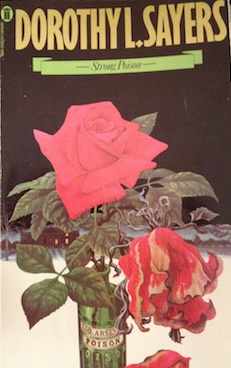
A mystery setting has additional jobs besides painting the landscape. Ideally it draws us straight into the plot, shaping our view of the characters. Here’s the beginning of Sayer’s Strong Poison:
“There were crimson roses on the bench; they looked like splashes of blood.
The judge was an old man; so old, he seemed to have outlived time and change and death. His parrot-face and parrot-voice were dry, like his old, heavily-veined hands. His scarlet robe clashed harshly with the crimson of the roses. He had sat for three days in the stuffy court, but he showed no signs of fatigue.
He did not look at the prisoner as he gathered his notes into a neat sheaf and turned to address the jury, but the prisoner looked at him. Her eyes, like dark smudges under the heavy square brows, seemed equally without fear and without hope. They waited.”
Already we’re caught, sensing the prisoner’s peril. Immediately we must turn to the next page.
Or Tony Hillerman’s first paragraphs in The Ghostway:
“Hosteen Joseph Joe remembered it like this.
He’d noticed the green car just as he came out of the Shiprock Economy Wash-O-Mat. The red light of sundown reflected from its windshield. Above the line of yellow cottonwoods along the San Juan River the shape of Shiprock was blue-black and ragged against the glow. The car looked brand new and it was rolling slowly across the gravel, the driver leaning out the window just a little. The driver had yelled at Joseph Joe.
“Hey!” he’d yelled. “Come here a minute.”
Joseph Joe remembered that very clearly. The driver looked like a Navajo, but yelling at him like that was not a Navajo thing to do because Joseph Joe was eighty-one years old, and the people around Shiprock and up in the Chuska Moutains called him Hosteen, which means “old man” and is a term of great respect.”
Hillerman has us. Shiprock silhouetted against a sunset, the Chuska Mountains, Navajo tradition being violated––we’re hooked by this authoritative voice placing us where we wanted to be, in Navajo country.
Strunk has other words for us writers as well. His Rule 14, Avoid Fancy Words: “Anglo-Saxon is a livelier tongue than Latin, so use Anglo-Saxon words.” I checked: “word” itself is Anglo-Saxon. https://www.etymonline.com/search?q=word
This instruction helps mystery writers follow several other rules, such as not overwriting, and choosing powerful verbs and specific nouns. See page two of Hillerman’s The Dark Wind:
Lomatewa glanced past the rabbit brush at the second boot. It matched. Beyond the second boot, the path curved sharply around a weathered granite boulder. Lomatewa sucked in his breath. Jutting from behind the boulder he could see the bottom of a foot. The foot was bare and even from where Lomatewa stood he could see there was something terribly wrong with it.”
Here he uses mainly (not all) Anglo-Saxon words, though some traveled from Latin through old French.
When I’m writing I’m always aware of Strunk’s strictures (uh-oh, late Latin). Indeed, I should probably reread him every week. But in working on this seventh mystery I also hope to discover “an eyeful of silver”, or “the smell of charred stone”, or move through “dozens of weathers,” or more.
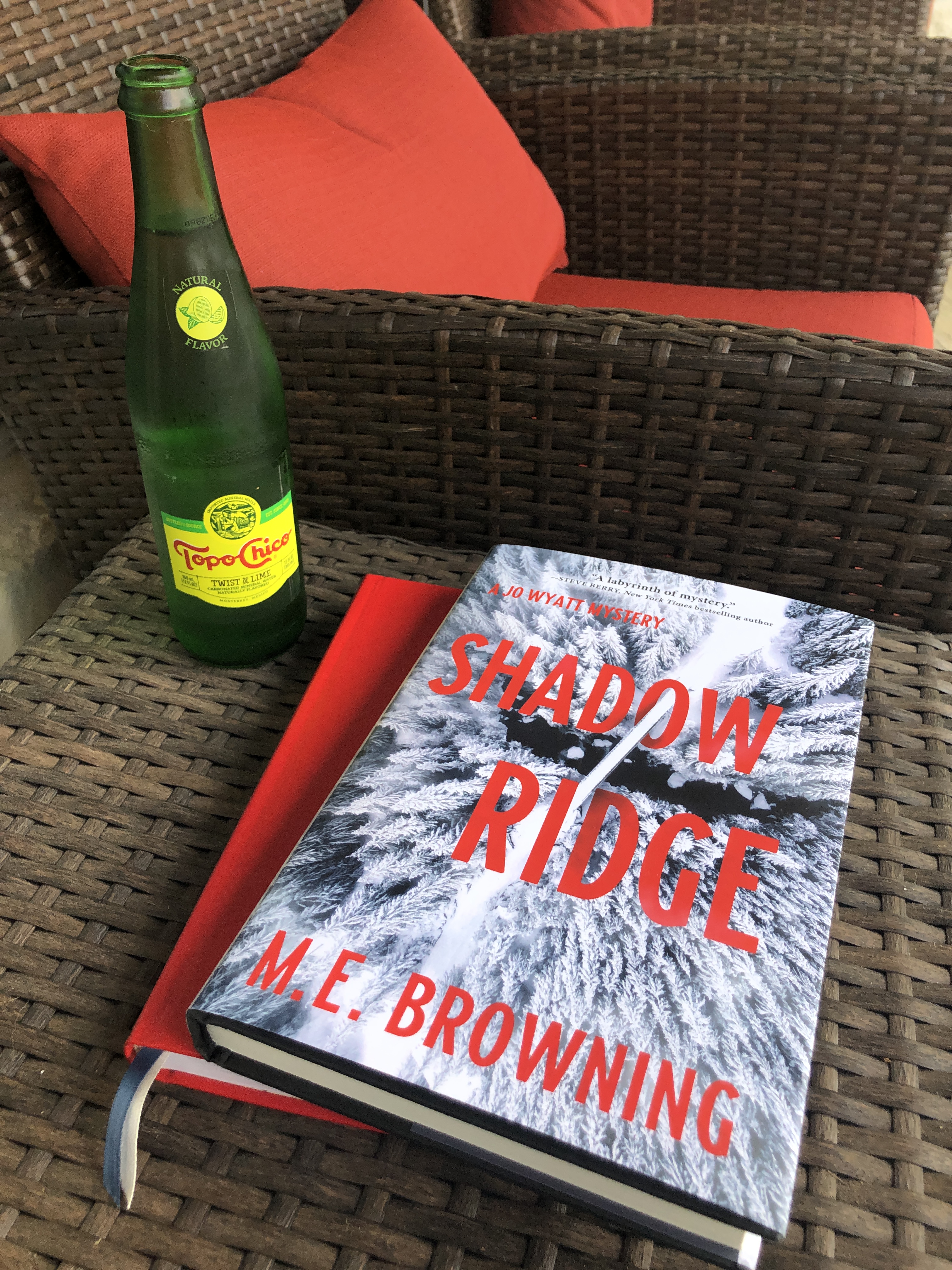
When it comes to writing riveting police procedurals, M.E. Browning has all the credentials. As a retired police captain and an award-winning author, she follows her Agatha-nominated series featuring amateur sleuth Mer Cavallo with Colorado police detective Jo Wyatt in her latest novel, SHADOW RIDGE. Readers and reviewers alike have praised Browning’s meticulous plotting and storytelling prowess as she brings us into the Colorado town of Echo Valley and the case that plunges Detective Jo Wyatt into the dangerous underworld of online gaming. Browning shares how SHADOW RIDGE came to be and what’s next for both her and Jo Wyatt.
SHADOW RIDGE was just released this week. Congratulations! What would you like readers to know about your latest novel?
SHADOW RIDGE, A Jo Wyatt Mystery
I think every author has a story that they are afraid to write–not because the content is necessarily frightening, but because it means so much to the author. For me, that book was Shadow Ridge. When I first started writing, I knew I hadn’t yet developed the skill to write this story—at least not the way I wanted. I’d tried. Despite being my third published book, Shadow Ridge is my first police procedural. It’s also my first novel to earn a starred review. In hindsight, I think it’s good to be a little scared of your story. It kept me digging until I found the emotional core of each character.
What drew you to writing SHADOW RIDGE? How did the story idea come about?
I’d read an article that detailed the misogyny that female gamers faced online. Sadly, when it comes to online abuse, women are overwhelmingly the target. In the gaming industry, that abuse flared into coordinated mob attacks. Typically, online abuse manifests in three ways: trolling, doxxing, or SWATting. We’ve all probably experienced a troll—someone who hijacks a thread and makes racist or abusive comments. In some cases, trolls escalate their behavior into doxxing, which occurs when they post a victim’s personal information online. Armed with doxxed information, a harasser can morph from an online threat into a physical one and confront the woman personally or report a phony emergency that requires a SWAT response. Obviously, when a tactical team surrounds a house because someone inside reportedly has a gun and is threatening to kill another occupant, tensions are high and the danger is real—even if the emergency isn’t.
From a law enforcement perspective, cybercrimes are difficult to investigate. Harassers hide behind firewalls and phony accounts, and while they may be as close as your neighbor, they could also live on the other side of the globe. Many smaller jurisdictions don’t have the training or resources to investigate the crime and end up referring the case to a state agency.
From a story perspective, I saw an opportunity to bring these two worlds together. The game designer runs afoul of online abuse which brings her in contact with Detective Jo Wyatt and parallels issues Jo’s’s facing within the department. And as authors like to say in an effort to avoid spoilers, shenanigans ensued.
Tell us about Jo Wyatt and her life in Echo Valley.
Jo is a second-generation cop in a small southwestern Colorado city. She’s been on the force for a dozen years, and the last two have been as a detective. I had a NetGalley reviewer describe Jo as “Smart enough to know her limitations, confident enough to trust her gut, and determined enough to unravel the threads in any case.” I almost wept reading that description because that was exactly the character I wanted to portray.
Echo Valley is urban enough to have a craft brewery, but rural enough that the bears still rummage through the trash at night. Working in a small community has its pros and cons. Jo frequently knows the people she deals with, but they often expect her to let them get away with murder.
Your past career in law enforcement has been highlighted in early reviews, with readers praising your experience coming through in a way that is masterful without being dominant. How did you decide how much of that expertise to use in SHADOW RIDGE?
The short answer is trial and error.
My earlier unpublished manuscripts proved that writing what you know isn’t always the best approach to a compelling story if you include too much extraneous detail. Instead, I discovered I needed to learn how to let law enforcement informa story. So instead of a law enforcement professional, an amateur sleuth stars in my first two books. With each novel, my understanding of the value of specific details increased. It was also important to me to portray Jo as human. She makes mistakes, but she owns them. It was a lot of fun for me to bring her to life through the other two point-of-view characters.
This is the first in the Jo Wyatt series, correct? Can you give us any insight on what is coming next for you? And for Jo?
That is correct. I’m currently working on the second Jo Wyatt Mystery. In it, Jo investigates a missing child, but as she digs into their fractured family life, she unearths a trove of secrets and half-lies that paint a different picture of the two parents she’s known since high school.
What do you hope readers will take away from this book?
Part of the joy I discover when reading a book is what lies hidden between the lines—and everyone’s experiences determine how they will interpret the same event. In Shadow Ridge, I explore the complexity of family, the meaning of promises, and the danger of secrets. But in the end, when the last word is read and the book is closed, I hope readers believe that Jo is exactly the cop they’d want to respond if they ever need to call for help.
M.E Browning
M.E. BROWNING served twenty-two years in law enforcement and retired as a captain before turning to a life of crime fiction. Writing as Micki Browning, she penned the Agatha-nominated and award-winning Mer Cavallo mysteries, and her short stories and nonfiction have appeared in anthologies, mystery and diving magazines, and textbooks. As M.E. Browning, she recently began a new series of Jo Wyatt mysteries with Shadow Ridge.
Micki is a member of Mystery Writers of America, International Thriller Writers, and Sisters in Crime—where she served as a former president of the Guppy Chapter. A professional divemaster, she resides in Florida with her partner in crime and a vast array of scuba equipment she uses for “research.” Visit mebrowning.comto learn more.
You can find SHADOW RIDGE at your favorite bookstore or online here.
Ninety years ago the first Nancy Drew mystery, The Secret of the Old Clock, was published. Since then, over 70 million copies of that series have been sold. The fictional female teenage sleuth was originally conceived by publisher Edward Stratemeyer, whose other brainstorms included The Hardy Boys, and my personal favorite as a five-year-old, The Bobbsey Twins. (Okay, I’m old. Get over it.)
Believe it or not, Stratemeyer firmly believed in traditional roles for women, but his mostly female ghostwriters under the shared pseudonym of Caroline Keene, had different plans. Mildred Wirt, who wrote 23 of the first 30 Nancy Drew books, turned Nancy into a fierce, fearless, feminist heroine that inspired young girls to be the same ever since the books hit the shelves. Many prominent and glass-ceiling-shattering women count Nancy Drew as an inspiration in their youth including First Ladies Hillary Clinton and Laura Bush and Supreme Court Justices Sandra Day O’Connor, Sonia Sotomayor and the recently departed and dearly loved Ruth Bader Ginsburg.
Oddly enough, critics panned the series when it first came out. Nancy broke too many stereotypes, being frequently outspoken and authoritative. Librarians, educators and parents also considered the books too “formulaic” and feared they would negatively impact young readers and their future book choices.
As you may recall, they said the same thing about J.K. Rowling’s Harry Potter Series.
The Secret of the Old Clock is the mystery that began it all for America’s controversial female teenage sleuth. In this story, sixteen-year-old Nancy wishes to help the Turners, who are struggling relatives of the recently deceased Josiah Crowley, find the missing will would give them claim to the Crowely’s estate. She becomes interested in the case because she disliked Crowley’s snobbish nouveau-riche social-climbing heirs.
Justice for the downtrodden? Fighting for the underdog? Outspoken? Authoritative?
Sounds familiar. Rest in Peace, RGB.
K.P. Gresham is the author of the Matt Hayden Mystery series and Three Days At Wrigley Field.

 Holiday in Death is the seventh in the now fifty-one book series about New York murder cop Eve Dallas and her devastatingly rich, handsome and techno-wizard husband, Roarke. Did you catch that? There are fifty-one books in this series, with the next, Faithless in Death, coming February 9, 2021.

















 Austin Mystery Writers