Sisters in Crime, Thank You!!!

By K.P. Gresham

First off, the best job I ever had (short of writing mysteries) was teaching. And yes, I taught Middle Schoolers, which most people think is the worst possible teaching job you can have. Not me. I loved the students, and I loved my fellow teachers and staff. The kids were sponges. As long as you weren’t a jerk to them, they weren’t a jerk to you. And when they succeeded, both teacher and student won. The same could be said for all of us school employees who came to work every day to help those students become educated, excellent citizens.

What does that have to do with Sisters in Crime? Well, this time I’M the student, and my fellow chapter members and I are the sponges, learning as much as we possibly can to be better writers, readers and business people.

Sisters in Crime (SinC), both on the national level and the chapter levels, provides the teaching. The organization is based solely on helping readers and writers, women and men to learn their craft and sell their books.

SinC is the premier crime writing association focused on equity and inclusion in our community and in publishing. The association, founded in 1986, has 4500+ members who enjoy access to tools to help them learn, grow, improve, thrive, reinvent if necessary, and to share the lessons they’ve learned during their mystery writing experience.

4500+ members? That’s a whole lot of folks to learn from!

SinC National offers many resources to mystery readers and writers. They support a large international network of local chapter with grants, webinars, a central bank of crime-writing research, etc. They support local libraries and independent bookstores. National also provides a monthly newsletter called inSinC which is sent to every member.

Local chapters are where the meatiest teaching takes place. In the last year, our Heart of Texas Chapter centered in Austin, Texas, hosted a plethora of programs spanning the mystery writing need-to-know list. NY Times Bestselling author L.R. Ryan shared her secrets to plotting the blockbuster novel. Cathy DeYoung, a former LAPD CSI fingerprint analyst (and the inspiration for the character of Abby on the TV show, NCIS) walked us through the steps of exploring a crime scene. Mike Kowis, a mild-mannered tax attorney for a Fortune 500 company AND a fellow author, taught us the ins and out of the tax code for authors and other legal matters.  Oh, and we were graced with a frank Q & A with the U.S. District Judge of the U.S. District Court for the Western District of Texas.

Honestly. Why would a writer not want to learn from these experts??  And these incredible lessons all were brought together through the Sisters in Crime organizations.

Once you get past the realization that we kill people for a living (on the page, of course), crime writers and readers are a very supportive, very giving group of people. And Sisters in Crime is the best way to get to know them.


***

FLIGHTS OF FANCY AND IMAGINATION

BY FRANCINE PAINO

PBS television presented a new musical production by Grammy, Emmy, and Tony Award winner John Mauceri: The Nutcracker and the Mouse King, written in 1816.  Mauceri conducts the Royal Scottish National Orchestra, with Tony Award- winning Alan Cumming narrating this original tale in three parts.

The story written by E.T.A. Hoffman, is about a young girl who saves a prince, contrary to Cinderella, Sleeping Beauty, and Snow White, where the prince rescues the girl. Perhaps Hoffman’s inspiration for this particular flight of fancy was the popularity of embellished nutcrackers, which appeared in Germany in the early 1800s.  

The Nutcracker’s story began with a young boy who had to stay at home alone every day while his parents went to work. The little boy was lonely and afraid, so his father carved him a special toy, a  nutcracker in the form of a soldier with big sharp teeth and fierce-looking eyes and told him that this unique nutcracker would protect him while his parents were gone. It did the trick. The boy loved and enjoyed that nutcracker and felt secure by its presence, so his father continued to carve new ones for him.  When the boy grew up, he married and had a son to whom he gave all the nutcrackers made by his father.  

Over time in early 19th century Germany, the lure of decorative nutcrackers grew and so did a legend. They came to represent power, strength, and the protection of families from danger and evil spirits. Nutcrackers were given as gifts and keepsakes to bring good luck.  

E.T.A. Hoffman was a prolific writer of gothic tales, fantasy, and the supernatural – most of them dark including segments of his Nutcracker and the Mouse King. It was Alexander Dumas, the 19th-century French author who translated Hoffman’s work in 1845, propelling it beyond the written word.  Mauceri explains that Dumas, the grandson of the French aristocrat and African Haitian slave, was drawn to the story because Hoffman concluded the tale with the girl growing up to become the queen of a land of tolerance and imagination. It was the Dumas version that Peter Illich Tchaikovsky adopted in 1892, when he composed the score. 

          While this production does not target children, it is appropriate for those youngsters who can sit still for a narrative without pictures or characters to hold their interest. Cumming reads the narrative with emotion and even injects moments of humor without straying from the story.

The orchestra gives a stirring performance. Bold and rousing where appropriate, mysterious, sensual, and nerve-wracking also when appropriate. In addition to the lush Tchaikovsky score, compositions from Tchaikovsky’s tone poems and orchestral suites, are included in this score.  

           Mauceri’s reimagined Nutcracker and the Mouse King fill the mind’s eye with characters, places, and emotions generated by the performances of artists of the highest caliber. If you didn’t experience this fantastic flight of fancy and imagination, you could see it by accessing  https://www.pbs.org/video/the-nutcracker-and-the-mouse-king-meabwt/ 

         And now, in the true spirit of the season, love, kindness, respect, and caring, I wish all a Merry Christmas.


The Comfort of (Fictional) Friends

By Laura Oles

Anyone else enjoy re-reading favorite novels?

After a year immersed in reading new releases by talented authors, I’ve taken a step back and retreated to the comfort of reading (and watching) some of my all-time favorite series characters. When life gets stressful, curling up in a corner for a few minutes at night with a beloved character is one of my favorite ways of tuning out the chaos of the day. 

Here are a few of my favorite series characters: 

BOOKS:

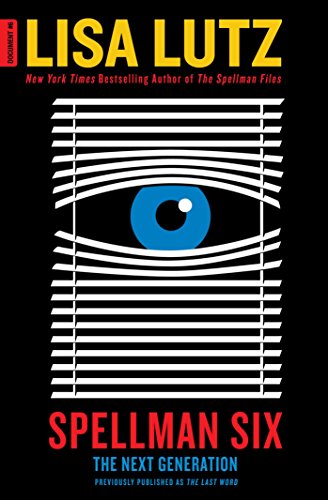
Lisa Lutz

Isabel (Izzy) Spellman: Isabel Spellman has been described as “the love child of Dirty Harry and Harriet the Spy,” which is one of the many reasons I love this character. As a licensed investigator in her family’s firm, she’s extremely capable and sharp, even as she navigates the pitfalls that come from working with her dysfunctional family. Her cleverness has an edge that keeps me turning the pages, and her sarcasm always sticks the landing. 

V I Warshawski:  I’m drawn to a strong and complex female protagonist, and VI absolutely fills this role. She doesn’t apologize for who she is and how she makes her way in the world. VI is skilled in a street fight, appreciates Torgiano red wine and doesn’t suffer fools. What’s not to love?

Tess Monaghan:  I discovered Tess during a time when my career required a great deal of travel. I picked up Baltimore Blues and never looked back. Tess’s investigative journalism background and her balance of strength and compassion compelled me to continue with the series. Laura Lippman gives us such a layered and authentic view of Baltimore through Tess’s eyes. And Tess ventured to go where few female detectives have dared—motherhood.

TELEVISION:

Sergeant Catherine Cawood/Happy Valley:  The first five minutes of Happy Valley remains, for me, one of the best openings I’ve ever seen in a series pilot. Sgt. Catherine Cawood is a dedicated police community officer working for the West Yorkshire Police Department.  Her personal life is enormously complicated, and a particular case consumes her (with damn good reason). Sgt. Cawood comes across as fully human, with a wit sharp enough to slice iron, and offers zero apologies for who she is and the choices she makes. 

Deputy U.S. Marshal Mary Shannon/In Plain Sight: Mary Shannon is U.S. Marshal working for the Federal Witness Protection program.  She’s a skilled investigator with a highly tuned (and hard-earned) understanding of human nature. Her complicated family backstory (her father is on the FBI’s most wanted list) informs her views on her cases and charges, but she’s first and foremost an outstanding hunter and protector. And her banter with her partner Marshall is pure gold.

Jim Rockford/The Rockford Files:. When I think about private detectives on television, my mind always goes to Jim Rockford. Maybe because he kept me company in my childhood. An ex-con who served time in San Quentin and then was later pardoned, he ran his investigative business out of a mobile home in LA and preferred fishing to most other pursuits. His father never felt being a PI was a real job, and the fact he was often getting shorted by clients didn’t help his end of the argument. Jim Rockford was fallible times, skilled at working cold cases but not always coming out on top in a brawl. He rarely used his gun. He was human, and I find that particularly appealing. And that theme song is pretty catchy, too.

Who is your favorite go-to series character? And why?

….And Then What Happens?

By Helen Currie Foster

If you haven’t read Richard Osman’s The Thursday Murder Club, or his latest, The Man Who Died Twice, fear not—no spoilers here. Oh, maybe a couple of teases, but that’s my theme today: curiosity as a driver of mystery novels.

George Saunders, in A Swim in a Pond in the Rain, his boldly subtitled “master class on writing, reading and life,” recounts his experience submitting a short story to Bill Buford, fiction editor of The New Yorker. After receiving some “painful edits,” Saunders asked Buford what he liked about the story: “Well, I read a line. And I like it…enough to read the next.”

Saunders gives a short answer to why we keep reading: “Because we want to.” And why do we want to? “That’s the million-dollar question. What makes a reader keep reading.”

Back to The Thursday Murder Club. We meet the varied characters of an upscale home for the elderly in scenic Kent who meet weekly to solve murders—old and new. Some characters seem ordinary, like the new club member, Joyce, whose journal depicts her as sprightly and slightly ditzy. Some, like Elizabeth, are veiled in mystery. Is Bogdan just a dumb Polack? We begin to wonder what’s he hiding. Then we begin to wonder what each character’s hiding. We also desperately want to know who’s buried—no, who else is buried––in the nuns’ graveyard on the hill. We read in the bathtub. We sneak our Kindle into the examining room and finish another chapter before the nurse arrives. Same with The Man Who Died Twice: we keep reading the next line! Before beginning, I asked myself, how can Orman’s second book be as compelling as Thursday? Just hide and watch. For each character—whether detective or potential villain—a slow (but never too slow) reveal will move you, the reader, to keep reading the next sentence.

In my blog Curiouser and Curiouser I mentioned astrophysicist Mario Livio’s book, WHY: What Makes Us Curious. https://www.amazon.com/Why-What-Makes-Us-Curious-ebook/dp/B01M7WV0LV/ref=sr_1_4?qid=1638133468&refinements=p_27%3AMario+Livio&s=books&sr=1-4 Livio begins by discussing Kate Chopin’s “The Story of an Hour,” a very short 19th century tale of a woman who has just received news of her husband’s death. Livio cites Chopin’s “singular ability to generate curiosity with almost every single line of prose.” He says she inspires “empathic curiosity,” driving the reader incessantly to ask “why?” and to try to understand the desires and thoughts of the protagonist. Chopin also uses the element of surprise—“a sure stratagem to kindle curiosity through heightened arousal and attention.”

The physiological basis for such heightened curiosity? When we encounter the unexpected, our brains assume we may need to take action. “This results in a rapid activation of the sympathetic nervous system” as we focus on the key issue, says Livio. He notes that when we’re surprised and have a fear response, both fast and slow brain pathways are activated. On the fast track, our thalamus sends sensory signals to the amygdala which directs our emotional response. But on the slow track, our thalamus sends signals to our cerebral cortex before going to the amygdala—allowing a “more thoughtful” response. 

And don’t mystery readers have highly developed cerebral cortexes? Of course they do. For starters, though, we request a protagonist who engages us, so our empathic curiosity can push us to the next sentence. Perhaps we need to care at least a little for the protagonist in order to want to know what happens next. All the great tales combine empathic curiosity and surprise. Will Kim and his lama find the River of the Arrow? Will Mr. Darcy ever propose a second time to Elizabeth Bennet? Will Gus and Call survive the cattle drive to Montana? Will Frodo make it to the Cracks of Doom? Will George Smiley figure out the mole’s identity? We want to know what happens next. Mystery readers beg their authors: make us want to know!

Livio highlights some remarkably curious humans. One is Leonardo da Vinci (described by art historian Kenneth Clark as “the most relentlessly curious man in history”). A look at Leonardo’s Notebooks shows as just one example of his curiosity his study of human physiology [186] and anatomy—skeleton, musculature, circulation.

Leonardo provides detailed drawings and descriptions of human limbs, and then moves on to how they work: “The walking of man is always after the universal manner of walking in animals with 4 legs, inasmuch as just as they move their feet crosswise after the manner of a horse in trotting, so man moves his 4 limbs crosswise; that is, if he puts forward his right foot in walking he puts forward, with it, his left arm and vice versa, invariably.” We come to believe Leonardo was not just trying for painterly accuracy: he wanted to know how bodies work (as well as why candle flame moves as it does, how screws and tempered springs work, how to depict perspective…).

It goes almost without saying that mystery readers are notoriously curious. We love to plunge into new or unique settings—Alaska (Dana Stabenow), Southside Chicago (Sara Paretzky), Scotland (Ian Rankin), the south of France (Martin Walker), the Four Corners (Tony and now Anne Hillerman)…and don’t forget Texas, big cities and small towns, the coast, the border, the Hill Country. We’re delighted with new worlds—paranormal mysteries. We’re curious about alibis—any holes? What exactly did the medical examiner say? Which facts point to a motive—or lack thereof? 

Another example of a “relentlessly curious” human is astrophysicist Richard Feynman: “Feynman’s genius and achievements in…physics are legendary…He became known to the general public as a member of the panel that investigated the space shuttle Challenger disaster…When asked to identify what he thought was the key motivator for scientific discovery, Feynman replied, ‘It has to do with curiosity. It has to do with wondering what makes something do something.’” [10]

“What makes something do something.” And what makes someone do something. The stuff of mystery.

Livio considers the drive for knowledge a deeply human characteristic, with curiosity a powerful force not just for childhood cognitive development, but for intellectual and creative expression later in life. [9] He says “perceptual curiosity” motivates visual inspection—for instance, when we see something novel, puzzling, or an extreme outlier. Opposite “perceptual curiosity” is “epistemic curiosity”—sheer desire for knowledge, which Thomas Hobbes called “lust of the mind” because it only leaves you wanting more. 

Well, isn’t that your basic mystery reader? The best mysteries leave us momentarily satisfied—we want to read each next line until we get to the very last line—but still wanting more. Where’s the next book?

Helen Currie Foster writes the Alice MacDonald Mystery Series, and lives north of Dripping Springs, supervised by three burros. Find the series at BookPeople, Amazon or IngramSpark and at various libraries. The books (Ghost Cave, Ghost Dog, Ghost Letter, Ghost Dagger, Ghost Next Door, Ghost Cat, and Ghost Daughter) include “Ghost” in their titles because an old sin, old love, or old death still hangs around…resulting in a new murder. Ghost Cat won “Semifinalist” for Mystery in the Next Generation Indie Book Awards. Kirkus says of Ghost Daughter, “An appealing character headlines a solid thriller with panache.” 

Follow her at http://www.helencurriefoster.com,

https://www.facebook.com/helencurriefoster/

A Little Hitchcock, Two Stories, Plus Spoilers

by Kathy Waller

The summer  I was six, my cousin of the same age was visiting our spinster great-aunt and bachelor uncle who lived up the street. Uncle called one evening. Cousin was being a major pain. It was a weeknight, and the only amusement our miniscule town afforded, a roller skating rink, was open only on weekends. Great-aunt and uncle weren’t accustomed to dealing with children of the painful variety, so he did what he often did when desperate. He appealed to my mother: You’ve got to do something.

A veteran of dealing with a juvenile pain, she proposed the perfect solution. They loaded both of us into the car and took us fifteen miles to the drive-in movie.

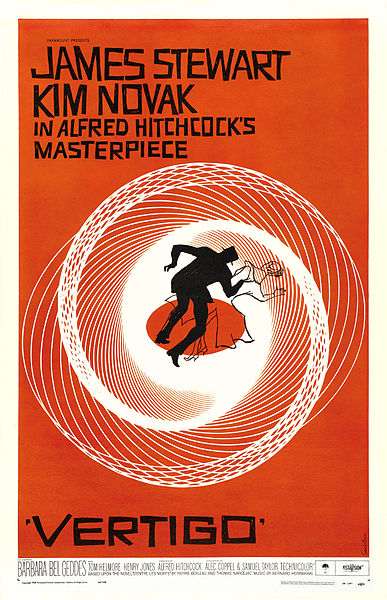
An excellent plan: Bugs BunnyPorky Pig, trailers of coming attractions, and the feature film: Alfred Hitchcock’s Vertigo.

synopsis of the novel from which the movie was adapted appears on Wikipedia:

A prosperous shipbuilder hires a former detective who suffers from vertigo to tail his wife Madeleine who is acting strangely. The detective falls in love with the shipbuilder’s wife but is unable to stop her committing suicide by jumping from a tower. Haunted by her death, he sees a woman who bears a strong resemblance to the dead woman, however, his attempts to get closer to this doppelgänger ultimately result in tragedy.

In these enlightened times, many, if not most, parents would be horrified at anyone’s allowing a first-grader to see such a nightmare-inducing movie. I, however, spent every afternoon glued to the Afternoon Movie. I guess my mother assumed that if I could handle Don Ameche trying to get rid of his wife, Claudette Colbert, by drugging her hot chocolate and then piping in repeated suggestions that she jump off her bedroom balcony, Hitchcock wouldn’t upset me.

And I’ve always been grateful to her, because that night at the drive-in, I fell in love. I watched Hitchcock’s television programs and all the movies I could manage. They were wonderful, and if they starred Cary Grant–Francine Paino wrote about one of those, North by Northwest, last week–that was icing on the cake.

Now Netflix, Prime, Roku, and other streaming services have allowed me to watch many of them again.

But this post isn’t a celebration of Hitchcock. It’s about two stories adapted for his television show. Watching them as an adult, I saw something I hadn’t seen years (and years) ago. I enjoyed both, but one had something extra.

The first is “The Second Wife,” in which a mail-order bride comes to believe that her husband plans to kill her. At the outset, he seems insensitive, unconcerned about her needs; when she says the laundry room in the basement is uncomfortably cold, he complains about the cost of installing a heater. She also hears

stories: he took his first wife to visit her people at Christmas and she died and was buried there–or that’s what he claims.

Gossip fuels the second wife’s fears, and when the husband announces plans to take her home for Christmas, she acquires a gun. Before they leave, however, he insists she go down to the basement. She takes the gun and descends the stairs. He’ll follow in a moment.

The viewer feels her fear: The husband will kill the second wife, as he killed the first.

But there’s a literary catch. In a letter, Anton Chekhov stated one of his principles for writing fiction: “One must never place a loaded rifle on the stage if it isn’t going to go off. It’s wrong to make promises you don’t mean to keep.”

The wife has a gun. And this is Hitchcock; he keeps his promises.

The wife shoots and kills her husband, then realizes he’d only wanted to show her her Christmas present–the heating system he’d had installed in the laundry room.

A tragic ending, but satisfying in its irony.

The second story, “Night of the Owl,” however, has something extra, something unexpected.

A couple have reared an adopted daughter, now a teenager, a bright student, a well-adjusted, happy girl. But the parents have carefully guarded a secret: the girl’s father murdered her mother, then killed himself in prison. When a prison chaplain and his accomplice appear and blackmail the couple, then come back for more, the father considers his options: murder the blackmailer, or tell his daughter about her past. Both are unthinkable. Then one of the blackmailers is murdered. Evidence points to the father.

How can the plot be resolved? Did the father commit murder? He escapes being charged but can’t escape telling his daughter about her birth parents.

In “The Second Wife,” the resolution is either/or, and the viewer can almost certainly predict which it will be.

But the ending of “The Night of the Owl” isn’t predictable. Will the girl become hysterical? Fall into depression? Reject her adoptive parents? Run away? Harm herself?

Told the truth about the murder/suicide in her background, she expresses empathy. How unhappy her parents must have been, she says–what sad lives they must have lived.

I didn’t see that coming. A Hitchcock program with a happy ending. And an exceptional character.

Critics (professional and amateur) point to problems with both  programs. Fair enough. I didn’t watch for flaws. In fact, I didn’t watch for anything but the pleasure of seeing programs I’d first watched as a child. I just happened to see something more.

And to quote Osgood Fielding III, “Nobody’s perfect.”

***

“Night of the Owl” is available on Youtube.

*

Robert Bloch wrote the teleplay of “The Second Wife” based on a story by Richard Deming. It aired on The Alfred Hitchcock Hour on October 4, 1962.

Richard Fielder wrote the teleplay of “The Night of the Owl” based on a novel by Paul Winterton. It aired on The Alfred Hitchcock Hour on April 26, 1965.

*

Joe E. Brown appears as Osgood Fielding III in Some Like It Hot. He has the best line in one of the best, and funniest, movies ever made.

Research turned up this biographical item: “An ardent opponent of the Nazi regime, in 1939 Brown testified before the House Immigration Committee in support of a bill that would allow 20,000 German-Jewish refugee children into the United States. He would later adopt two German-Jewish refugee girls himself, naming them Mary Katherine Ann (born 1930) and Kathryn Francis (born 1934).”

*

Images are taken from Wikipedia. Both are in the public domain.

***

Kathy Waller blogs at Telling the Truth, Mainly.


NORTH BY NORTHWEST –

Alfred Hitchcock at his Best 
By 
Francine Paino AKA F. Della Notte


      North by Northwest, a mystery thriller filmed in the 1950s, was Alfred Hitchcock at his best, and the movie received the 1960 Edgar Alan Poe Award for Best Motion Picture. 

       The plot:  “A New York City advertising executive goes on the run after being mistaken for a government agent by a group of foreign spies, and falls for a woman whose loyalties he begins to doubt.” (quote from IMB). There are a few terms and facts viewers should know before settling down in the jammies with the bowl of popcorn (light, of course). Warning: Spoilers included.

      First—the Maguffin. An object or device in a movie or book that serves merely as a trigger for the plot and receives little in the way of explanations.  In a more current film, Titanic, the search for the Heart of the Sea diamond necklace is the trigger that drives the plot and the action, but Hitchcock popularized the concept of the maguffin. In North by Northwest, there are two: The microfilm of government secrets that James Mason’s character, Vandamm is trying to sneak out of the country, and the identity of George Kaplan, who doesn’t exist – not even in the movie.  

      The movie begins in New York with a dramatic and dangerous encounter with foreign spies. Thornhill is mistaken for George Kaplan and is kidnapped, questioned, and almost killed by the Vandamm agents. He escapes and is then framed for the murder of Lester Townsend at the U.N. Grant/Thornhill begins his trek north by northwest by sneaking onto a train headed for Chicago, pursued by the evil foreign agents and the police. Here he meets Eva Marie Saint/ Eve Kendall, a confidant of Vandamm’s, played by James Mason.

      In Chicago, Grant/Thornhill leaves the train disguised as a porter with the help of Saint/Kendall and is set up to meet the elusive George Kaplan at the Prairie Stop, Highway 41, a little-used route more than an hour outside of Chicago. Here, Hitchcock creates a scene that became the forerunner for future action movies, especially the James Bond Series. 

      Hitchcock doesn’t do the usual dark city street motif for a deadly attack on Grant/Thornhill. Instead, Hitchcock has him vulnerable in an open field and targeted by a  small aircraft with firepower.  After diving to the ground several times, Grant/Thornhill sees a cornfield and runs for cover, but in comes the small aircraft again, this time employing its crop-dusting capabilities to cover him in a cloud of chemicals and flush him out.  As the small plane circles to make a second pass, a tanker truck barrels down the highway. Grant/Thornhill jumps out in front of it, forcing the driver to stop, but the small plane misjudges and crashes into the oil truck. Both explode.  Now a few innocent bystanders appear, traveling on this up-until-now deserted road. They stop their cars and get out, to get a closer look at the disaster.  Grant/Thornhill slinks past them, steals one of their vehicles, and escapes. 

      As the story unfolds, we discover who Eve Kendall is, and we learn there is no George Kaplan, but the most dramatic scenes that end the movie take place on the remarkable stone-carved Mt. Rushmore monument, where Grant/Thornhill and Saint/Kendall try to escape by descending the faces of Rushmore, pursued and shot at by Vandamm’s agents.  

      To my great disappointment, the only authentic shots of the remarkable stone carvings of Rushmore were from a distance.  Although Hitchcock had a permit to film at the monument, government officials banned the production when word got out that the writers scripted a fight scene and a couple of deaths. Thus, the hard work of climbing, falling, and fighting took place in Hollywood, and Mt. Rushmore was created by Hollywood trickery, using set pieces, special effects, and clever camera work—but don’t let that stop you from watching.

      Of course, like most movies of those times, the good guy (Thornhill) gets the girl (Kendall), and like so many Hitchcock thrillers, the drama is intense even when you know it’s Hollywood and how it will end, but politics aside, Mt. Rushmore is its own dramatic story. 

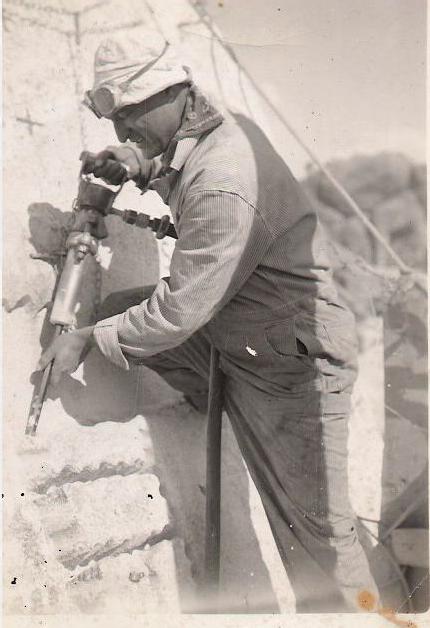
      John Gutzon de la Mothe Borglum created this remarkable feat of sculpting and engineering.  In the summer of 1925, at the age of 57, Borglum went to South Dakota and began the project. Work on the sculpture started in 1927. Borglum remained devoted to the project until he died in Chicago, and his son Lincoln put the finishing touches on his father’s vision. Sadly, however, what’s left out of this remarkable story is that in 1933, Borglum hired Italian immigrant, Luigi del Bianco as the chief stone carver and paid him $1.50 an hour. (Excellent pay in those days. ) Del Bianco was tasked with more than the rough work of blowing up rocks and carving out simple shapes. He was entrusted with many of the finer points of creating those faces.  Among his many duties, Del Bianco was entrusted with carving the detail in the faces. He cut Abraham Lincoln’s eyes and patched a dangerous crack in Thomas Jefferson’s lip. 

      Borglum constantly praised del Bianco for his outstanding abilities as a classically trained stone carver: “He is worth any three men in America for this particular type of work…. He is the only intelligent, efficient stone carver on the work who understands the language of the sculptor….We could double our progress if we had two like Bianco.”(Wiki)

      Despite Borglum’s high regard, del Bianco, the Italian, was ignored until finally, three-quarters of a century later, his family fought for and won the recognition he so richly deserved. In 2017, a plaque was placed at the monument to honor his work as the chief sculptor.

      So, one might say that North by Northwest is a mystery/ thriller filled with high drama both on and off the set, both fictitious and real. I’ve watched North by Northwest many times and always discover something new with each viewing.  

Enjoy!

Curiouser and Curiouser!

by Helen Currie Foster

At book groups I ask the beloved readers: “Why do we read mysteries?”

After a pause, for modesty, one honest person says: “We like to figure it out!”

Yes, we do. Why? Writer Patricia Cornwell, who created the forensic pathologist Kay Scarpetta, gives this answer as to why readers are fascinated by murder forensics: “To me, this goes back to our tribal survival instincts. If you can re-create a situation in your mind about what happened to someone, how that person died, there’s a better chance it won’t happen to you…[I]t’s part of the life force compelling us to look death in the face…We want to learn what happened…so we’ll feel less vulnerable about the same thing happening to us. It’s the kind of curiosity that propels us to study monsters.” https://amzn.to/3vQ3fPe

We want to know. Who killed Cock Robin? Who killed the two princes in the Tower—was it really Richard III? https://www.medievalists.net/2021/02/new-study-strengthens-claims-richard-iii-murdered-the-princes-in-the-tower/

 Was Henry II complicit in his knights’ gruesome slaughter of Archbishop Thomas Becket in Canterbury Cathedral? https://blog.britishmuseum.org/thomas-becket-the-murder-that-shook-the-middle-ages/ Curious humans still ask, who’s the guilty party?

Astrophysicist Mario Livio has been curious enough about curiosity to write a book on it: “Why? What Makes Us Curious.” https://amzn.to/3Gm7jLW

“Other animals are curious,” he says, “but only humans are worried and curious about reasons and causes for things. Only humans really ask the question, ‘Why?’” https://www.pri.org/stories/2017-08-27/why-are-humans-so-curious

While survival provides an evolutionary purpose for curiosity, Livio points out, “One of the things that researchers still don’t have an answer to, is that we, as humans, seem to be much more curious than what is just necessary for survival.”

According to Livio, we have two basic types of curiosity that show up in two different parts of our brains during MRI scans. One type is “perceptual curiosity”—what we feel when something surprises or puzzles us. “It is felt as a sort of uneasiness, an unpleasant situation … like an itch you need to scratch…,” he says. Yes, that creepy feeling, the hair on the nape of your neck prickling, because something doesn’t feel quite right. https://knowledge.wharton.upenn.edu/article/makes-us-curious/

The interesting thing about murder is that we seem convinced that ultimately, the murderer will be found out. At least as early as the 14th century, in The Canterbury Tales, Geoffrey Chaucer (c. 1343-1400) knew readers were sure they could identify a murderer. “The Priest’s Tale” tells us, “Though it may skulk a year, or two, or three, Murder will out…”

In Hamlet (c.1602)King Claudius fears detection of his murder of Hamlet’s father. He confesses at prayer, “O, my offence is rank, it smells to heaven; it hath the primal eldest curse upon it, a brother’s murder.” Act III, Scene 4. Hamlet has already announced in a soliloquy, “For murder, though it have no tongue, will speak with most miraculous organ.” Hamlet, Act II Sc. 2. Hamlet intends to play detective, sure that he himself can detect the king’s guilt by watching the king’s reaction to the play he has the actors perform: “I’ll observe his looks…if he but blench, I know my course.” 

Literary agent Anne Tibbets says mystery readers insist on understanding what happened. We are outraged if the author dares hide or suppress clues: we want a fair shot at solving the murder. We evaluate each potential suspect; we note physical clues; we scrutinize alibis; we use our own human experience to test the strength of each suspect’s motives. But as readers, of course we depend on the protagonist asking the right questions for us, identifying the victim, interviewing witnesses, examining the crime scene, noticing every salient detail. Each murder mystery effectively presents us with a miniature history of a crime, and we must absorb, and dissect, that history in order to satisfy ourselves we know “what happened.” 

Because we’re curious. Or, as Alice observes in her visit to Wonderland, “Curiouser and curiouser.” Lewis Carroll dubbed Alice “this curious child” and indeed, following Alice down the rabbit hole, we too want to know what the golden key will open and what’s behind the little door.

Alice is an indefatigable questioner. For instance, quizzing the Mock Turtle about his school days, she asks, “What else had you to learn?”

“Well, there was Mystery,” the Mock Turtle replied…”Mystery, ancient and modern, with Seaography…”

Mystery, for history, ancient and modern. The Mock Turtle is spot on. So much of history remains a mystery: no matter how many questions we ask, no matter how skilled and diligent the historian, no matter how thick the tome or how voluminous the footnotes,  we never have all the documents, all the testimony, needed to understand everything that happened during, say, the great convulsions of history. Just think of the unknown moments buried during Reconstruction, or the Spanish Civil War, or the Russian Revolution, or…  

Like Alice, mystery readers are “curiouser and curiouser.” The joy of being a mystery reader, after experiencing the miniature history within a good murder mystery, we reach the conclusion we’ve awaited. For once, at least, our curiosity is satisfied. We know “what happened.”

Author Helen Currie Foster lives and writes north of Dripping Springs, Texas, supervised by three burros. She writes the Alice MacDonald Greer mysteries, set in the small town of Coffee Creek, Texas, somewhere west of Dripping Springs and east of Fredericksburg. In Book 7, Alice finds herself in a lethal battle over hidden art and the victim’s will. Available on Amazon and IngramSpark, and at BookPeople in Austin.

Find her online: http://helencurriefoster.com/ and

https://www.facebook.com/helencurriefoster/

Detective Jo Wyatt Returns in Mercy Creek

By Laura Oles

For fans of M.E. Browning’s Shadow Ridge, the author returns with the second installment in the Detective Jo Wyatt series. Detective Wyatt has been called to investigate the disappearance of an eleven-year-old girl in the small Colorado town of Echo Valley. Today, Browning gives us a glimpse into Detective Wyatt’s world.

Mercy Creek, just released on October 12, is already garnering glowing reviews. Kirkus Reviews called Mercy Creek “a heartfelt procedural” and The Sun Sentinel calls it “a strong police story.” Browning’s extensive career as a police detective (she retired as a captain) informs this series well and does so in a way that the details of the work weave seamlessly through the larger narrative of the story.

LO: I’m sure readers are pleased to see that Jo Wyatt is back!  What has happened in her life since Shadow Ridge was published?

MB: First, thank you for inviting me back to the Austin Mystery Writers blog. A lot has happened in Jo’s life in the months following the blustery winter depicted in Shadow Ridge.  She’s moved forward in her personal life. Her divorce became final (although the thought of dating leaves her cold), and she’s made the decision to continue living in her childhood home with her father while she socks money away for a down payment on her own home. The biggest change on the work front is the appointment of a new Echo Valley Chief of Police. The opening pages of Mercy Creek find Jo working an extra-duty assignment on the night shift at the Echo Valley Fair. It turns into a very busy night with tremendous repercussions.

LO: Tell me about Mercy Creek and the current case that has Jo Wyatt’s attention. 

MB: A young girl goes missing, but the circumstances surrounding it are murky—including exactly when the young girl disappeared. For Jo, the case is personal. She was friends with the parents, Tilda and Lucero, in high school, but like many things that happened in high school, well, it’s complicated, and the friendships didn’t last as long as the hard feelings. The whole mess was a lesson, even if Jo didn’t quite know at the time what she’d learned. As she grew older, the lesson became clearer. People will do anything to protect the thing—or person—they love.

LO: You’ve written a series before with your Mer Cavallo books.  What was different about continuing a new series character? What did you enjoy? What did you struggle with?

MB: Marine biologist-turned divemaster Dr. Meredith Cavallo thought adjusting to a laid-back life in the Florida Keys would be a breeze after her regimented schedule on an Arctic research vessel, but of course, that wasn’t the case. In Adrift, she finds herself serving as the safety diver of a documentary crew in search of paranormal activity when one of the crew goes missing. As a scientist she is very analytical and methodical, which makes her a natural sleuth, but when she turns her focus to the disappearance, she quickly finds herself in over her head.

In contrast, Jo is a detective who has been on a rural police department tucked into the southwest corner of Colorado for fourteen years. She knows exactly what she’s signed up for and she’s good at her job, but that still leaves plenty of room for conflict when evidence doesn’t appear to match the situation. One of the perks about writing Jo was that she allowed me to return to my own law enforcement roots and incorporate my training and experience into her stories. 

What I enjoy about writing series is that I get to deepen relationships and explore new corners of Echo Valley that were established in the first of the series. The hard part is introducing returning characters or foundational settings so they are engaging to new readers without being repetitive for my established audience. To combat that, I focus on showing how a character’s environment influences who they’ve become and how it impacts their actions and reactions to their current situation. I wrote both Adrift and Shadow Ridge as stand-alone books. I thought I’d left everything on the table in those first books. But series are like a life well lived. There might be a passage of time, but the adventures never really stop.

LO: You write fondly about your home state of Colorado.  Tell us more about why you chose to set this series there.

MB: It was an honor to spend the last eight of my twenty-two-year law enforcement career as a member of the Durango Police Department. I was the first woman in the agency’s history to promote to Captain, I made lifelong friends there, and most importantly, Durango is where I met my husband. I’ve cycled the mountains, rafted the river, snow-shoed the trails, drank great craft brews, watched amazing plays and heard fantastic music. It’s a rural area steeped in tradition, while remaining forward looking and progressive. And yet, anytime you have a rural area, you have an elevated risk of danger. Like most of Colorado, the weather changes on a dime, animals encountered aren’t always friendly, and if you crash your mountain bike or suffer an injury on the trail, you could be on your own for quite some time. What better place to set a mystery? 

LO: If you had to describe the themes of Mercy Creek in three words, what would they be?

MB: Family. Loyalty. Secrets.

About M.E. Browning: Colorado Book Award-winning author M.E. Browning writes the Jo Wyatt Mysteries and the Agatha-nominated and award-winning Mer Cavallo Mysteries (as Micki Browning). Micki also writes short stories and nonfiction. Her work has appeared in dive magazines, anthologies, mystery magazines, and textbooks. An FBI National Academy graduate, Micki worked in municipal law enforcement for more than two decades and retired as a captain before turning to a life of crime… fiction. Visit mebrowning.com to learn more.

To pick up your copy of Mercy Creek, please visit here.

AND THE EYES HAVE IT!

BY

Francine Paino AKA  F. Della Notte

What exactly are these spherical bodies contained in the skull?  They appear as an orbit of different shapes, some round or oblong, curved, and dense, with a white membrane surrounding a circular colored portion called the iris.  The pupil centered in the iris is an opening through which light passes to the retina, making eyes the windows to the world. But they are so much more. As the saying goes, they are also the outside world’s windows to the soul. 

     There are over one hundred biblical references to the power of eyes. However, most in the Bible reflect the good and evil in the inner man/woman. In Matthew 5:28: But I say to you that everyone who looks at a woman with lustful intent has already committed adultery with her in his heart. Perhaps my favorite is Proverbs 21:4: Haughty eyes and a proud heart, the lamp of the wicked, are sin.  Moving from biblical times to today, eyes have not lost their power. 

Eyes are the most written about body parts as a symbolic expression and revelation of human emotions in songs. Body language too speaks, showing tension, joy, fear, mystery, but emotions pool in and project most powerfully from the eyes. The eyes are not limited in expression. Love, hate, justice, judgment, clairvoyance, even horror can be reflected in the eyes. 

As in biblical times, even in today’s world, these blinkers are often an extension of how the human soul projects itself. Some song titles express an individual quest. In The Eye of the Tiger, an athlete drives himself to reach the top of his game. In You Can’t Hide Your Lying Eyes, a woman cheating on her husband tries to tell him that she’s going to comfort a friend. Still, in her eyes, he sees the truth contradicting her words, and in Goodbye in her Eyes, a young man reads the end of a relationship in the eyes of the woman he loves.  

The range of emotions expressed in just one look runs the gamut from the depths of love to the depths of hate, and everything in between, including pain, jealousy, and mystery. Does anyone have difficulty understanding “his eyes blazed with fury,” or “her eyes softened with love when they placed the newborn baby in her arms?”  

On Goodreads, one finds a list of 278 books with body parts in the titles. But the eyes are used the most. In the words of Flannery O’Connor, who said that writers are painters with words, “Everything has its testing point in the eye, and the eye is an organ that eventually involves the whole personality and as much of the world as can be got into it.” One look can say more than a thousand words. Even closed eyes speak. Is the person avoiding something, someone, grieving, hiding?

Sometimes we even compare human eyes to animal’s. The fierceness of Tiger eyes as used in the above song title; the gentle loyalty of the dog gazing into his master’s eyes. Cats have fascinating eye language. Dilated pupils on a cat indicate excitement, while constricted pupils mean watch out!  This cat is angry and may be ready to attack. And, as all cat owners know, in those quiet moments, squinting eyes reveal a relaxed, happy feline, sometimes ready to fall asleep.  

As a writer, I’m very aware of the power of expression emanating from my human and feline characters.  In my Housekeeper Mystery Series, I can see their eyes and feel their emotions and the reaction those expressions generate in others. In the third book in the series, The Church Murders and the Cat’s Prey, one character has unusual amber-colored eyes with thick black lashes. Not only is the eye color striking, but one look from those eyes sends chills down our protagonist, Mrs. B.’s arms.  

There is no underestimating the importance of painting characters with words and showing the reader their body language, facial expressions, and most of all, the power of the messages cast from those orbits. Who doesn’t have warning bells go off when reading, “he smiled, but the smile didn’t reach his eyes,” or, “she said, ‘no harm done,’ but her eyes said there’d be hell to pay.”

There is even a blog about what the eye color tells you. Have some fun and try it at https://blog.freepeople.com/2013/09/eye-color-meaning/ 

Eyes can be so expressive, and in reality, words alone are not always necessary to have a conversation. 

Thus, the eyes do have it.

Two Roads Diverged…

by Helen Currie Foster, September 13, 2021

Have you noticed that the roads diverged in a yellow wood?

So Frost was thinking of fall, in “The Road Not Taken” (1916). Leaves turn yellow—and not just in New England. I admit Texas Hill Country fall colors are a little muted. Bluestem bunch grass makes silvery seed-heads.

big bluestem…

And our cedar elms turn yellow green, then yellow, and then madly fling golden confetti into the air.

Yellow leaves! When new roads appear and diverge, right? New fall clothes, perhaps (even with climate change) sweaters! New books, new subjects, new teachers, new classmates.

We awake with new ideas, new projects, new dreams. On weekends the parks fill up with soccer players. Football begins. 

All our years of fall classes leave many of us with a compelling interior calendar. In September, two roads—at least two roads!—diverge. We feel energetic, restless. Do we seek the old ways again or do new roads beckon? Do we join the Master Naturalists? Take a photography class? Go for a master’s degree? We feel September’s time pressure, expressed as a desire to learn new things, tread new paths, move further into the world, even with the stultifying blanket of the pandemic heavy on our shoulders.

As Yogi Berra famously advised, “When you come to a fork in the road, take it.”

Because—as Kurt Weill and Maxwell Anderson put it—

“It’s a long, long time from May to December,

But the days grow short when you reach September;

When the autumn weather turns leaves to flame

One hasn’t got time for the waiting game.”

You can hear Willie sing it, or Ella Fitzgerald, or Frank Sinatra, or others. https://www.youtube.com/watch?v=UslWN3LqPvYhttps://www.youtube.com/watch?v=f88yoLs0yl0

No, when September hits, we haven’t got time for the waiting game. It’s the first day of nursery school…third grade…middle school…senior year. We can’t just stay home and watch the leaves turn to flame. 

Now for Book 8. People ask about the “writing process.” It’s like standing at the crossroads in the yellow wood. Which path? But no time for the waiting game! 

Book 8 began to take shape with wakeful nights, with a couple of strong images, where Alice must identify a body in the Aberdeen mortuary. Then a new character barged in, demanding time onstage. I’m always amazed at how characters insist on doing what I hadn’t foreseen, taking their lives in their own hands. The plot arc is there but further decisions will be made. I’m sending chapters to the critique group, and the manuscript’s got at least a provisional name. The future murder victim in Coffee Creek hasn’t yet learned her fate (sorry, honey). So it’s still wakeful nights, then pacing around the kitchen island, then sitting and writing, then pacing again, then sitting and writing, then more pacing.

Just a moment ago it was summer. But as Frost also wrote, “Nothing gold can stay” (1923). The fall equinox approaches on September 22. Following Yogi Berra’s advice, faced with all the decisions ahead––who lives? Who dies, and how?––I’m heading down the road, yellow leaves and all.

AUTHOR Helen Currie Foster lives and writes north of Dripping Springs, Texas, supervised by three inquisitive burros. Find her books at BookPeople in Austin, and at IngramSparks and Amazon.

https://www.amazon.com/Helen-Currie-Foster/e/B00R1X9

You can follow Helen at

https://www.facebook.com/helencurriefoster/

Please visit the website at https://www.helencurriefoster.com