UNDER CLOSE OBSERVATION…

BY HELEN CURRIE FOSTER

May 18, 2026

One morning each year the bird genius, Jesse Huth, of Huth Avian Services, arrives from Wimberley to conduct our annual bird survey.

Every year I tiptoe along behind, hearing his soft announcements. “Green heron above the creek.” I look up, straining to spot the lovely heron in flight. While I’m wondering what it would be like to fly like that, I hear: “Red-tailed hawk.” Now Jesse’s facing a different direction, lifting his binoculars. Later, “American Redstart.” (I ask myself: what’s that?) We climb back up from the creek. Then, “Field sparrow. Lark sparrow.” (I peer, unsure of the difference.) Then off to the pasture. “Vireo, red-eyed.” “Vireo, white-eyed.” And “Vireo, yellow-throated.” 

Those vireos?—I never spot them, whatever they are doing––flying, darting, twittering, disappearing.

Then—such elation! Sitting boldly at the top of a tree we see the brilliant crimson of a summer

tanager, surveying its territory. https://macaulaylibrary.org/asset/657490711.

And in the same tree—golden-cheeked warblers! https://macaulaylibrary.org/asset/657490671

I’ve never seen one before. And finally, hiding in the branches, the ineffably gorgeous painted bunting! https://macaulaylibrary.org/asset/657490695

Jesse’s an expert on birds. He has studied their voices, their habits, their preferences, their appearance. He knows how to use owl calls to draw a crowd of various birds. After Jesse departs, I grab The Sibley Guide to Birds to study those three vireos (red-eyed, white-eyed, yellow-throated).

So tiny, the differences! You have to see the eye, where the yellow is, and where it isn’t; you must notice whether it has the gray cap, or not…
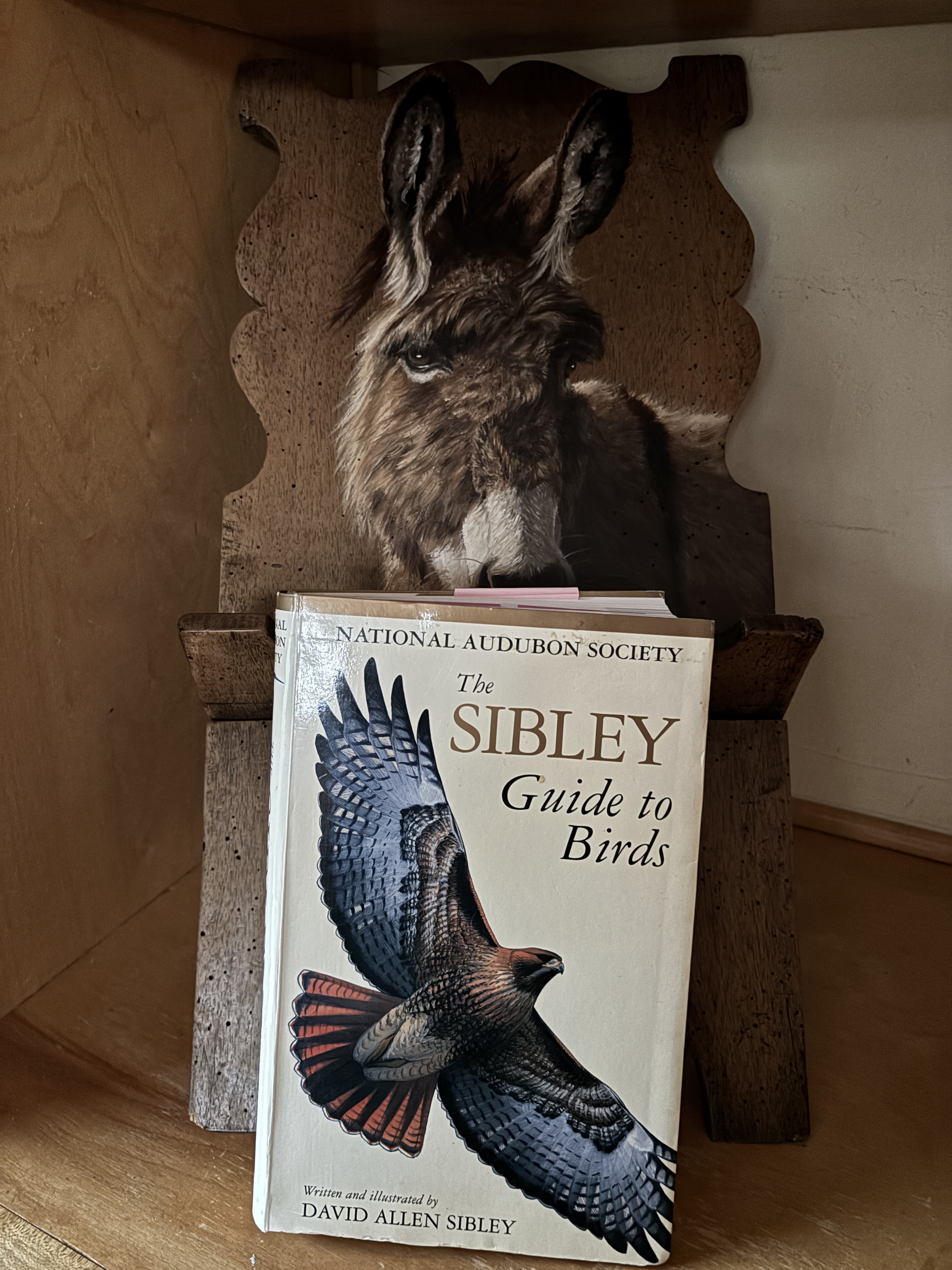
Jesse has spent years with those birds under close observation, yes, and under closer observation, applying his knowledge of detail. He sees differences that escape me. He can distinguish their songs.

After two hours he’s observed, and recorded or photographed, 40 species.

Details! Writers also must choose details that work, that light up, that bring to life characters and setting. That phrase—“under close observation”—describes the writer’s job: finding just the right details of setting, just the right details of characters, to make the plot come to life and satisfy the reader, the audience.

We all know great examples. In Act I, Shakespeare’s Julius Caesar closely observes Cassius:

            “Seldom he smiles, and smiles in such a sort

            As if he mock’d himself and scorn’d his spirit

            That could be moved to smile at anything.

            Such men as he be never at heart’s ease

            Whiles they behold a greater than themselves,

            And therefore are they very dangerous.”  Act I, Scene II.

Reading that, did you get a glimpse of Cassius’s face, as Caesar describes it? And hear that firm conviction, “therefore are they very dangerous”? Right away we begin to hold our breath.

I confess I do want to like the protagonist, whether in a play, a novel, a mystery, biography, autobiography. I do not need to approve entirely of that character, but, whatever the genre, I prefer to spend time reading about someone I can empathize with. So, turning to autobiography, consider these excerpts from the beginning of Out of Africa, by Isak Dinesen:

I had a farm in Africa, at the foot of the Ngong Hills. The Equator runs across these highlands, a hundred miles to the North, and the farm lay at an altitude of over six thousand feet. In the day-time you felt that you had got high up, near to the sun, but the early mornings and evenings were limpid and restful, and the nights were cold. …

We grew coffee on my farm. The land was in itself a little too high for coffee, and it was hard work to keep it going; we were never rich on the farm. But a coffee-plantation is a thing that gets hold of you and does not let you go, and there is always something to do on it: you are generally a little behind with your work.

…Later on, when I flew in Africa, and became familiar with the appearance of my farm from the air, I was filled with admiration for my coffee-plantation, that lay quite bright green in the grey-green land, and I realized how keenly the human mind yearns for geometrical figures.

With these details Isak Dinesen makes us see the farm and the Ngong Hills, then makes us feel the air at six thousand feet… with “lipid and restful” evenings. We feel her emotional attachment—“a coffee-plantation is a thing that gets hold of you and does not let you go.” Then she catches our imagination, describing seeing her farm from the air while flying, and shares her discovery that “the human mind yearns for geometrical figures.” Her own observations of detail reveal to us the protagonist, the main character in this autobiography, as a thinker, a noticer, a person with staying power, who once (but no longer) “had a farm in Africa”—and now offers to share that adventure. Her intelligence, her sensibility, her brilliant use of detail, kept me turning the page.

Another protagonist we meet and can’t abandon: Count Alexander Ilyich Rostov, of Amor Towles’s A Gentleman in Moscow. We’re introduced as the Count strides back from the Kremlin Gates to his home at the Hotel Metropol. On the way he greets the fruit seller, thanks the soldiers whose prisoner (we now perceive) he is, returns to his elegant suite—and learns that he has been dispossessed. He will spend the rest of his life in a tiny room in the hotel’s attic: “a cast-iron bed, a three-legged bureau, and a decade of dust.” He’s allowed to retrieve a few possessions. He wants “all the books” and also chooses two high-back chairs his grandmother’s oriental coffee table, porcelain plates, two table lamps, and the portrait of his sister…plus one trunk which he fills with clothes and personal effects, including his sister’s tiny scissors. We watch him take a last walk through his suite, then return to his tiny new room. A pigeon lands outside:

“Why, hello,” said the Count. “How kind of you to stop by.”

The pigeon looked back with a decidedly proprietary air. Then he scuffed the flashing with its claws and thrust its beak at the window several times in quick succession.

“Ah, yes,” conceded the Count. “There is something in what you say.”

I already liked this man, his exquisite courtesy to the pigeon, his apparent ability to laugh at himself, his apparent determination to stay himself, to refuse to give the state the satisfaction of causing him despair …despite the state’s efforts to destroy almost everything he has. Then I watch while he hosts a party for his friends in the hotel staff:

“The Count was something of a natural-born host and in the hour that ensued, as he topped a glass here and sparked a conversation there, he had an instinctive awareness of all the temperaments in the room.”

Personal tragedy, but humor, civility, sensitivity, courage—and determination. Okay, I’ll definitely keep reading.

Screenwriter Robert McKee, in his book Story about principles of screenwriting, points out that a story’s protagonist must have a conscious desire, but must also have the capacities, and at least a chance, to attain that desire. Also, according to McKee, “The protagonist must be empathetic; he may or may not be sympathetic.” Per McKee, “Empathetic means ‘like me.’ Deep within the protagonist the audience recognizes a certain shared humanity.”

McKee explains: “The unconscious logic of the audience runs like this: ‘This character is like me. Therefore, I want him to have whatever he wants, because if I were he in those circumstances, I’d want the same thing for myself.’” Amor Towles certainly accomplished that with Count Rostov.

So what details have kept you reading a book? What particular description made you think—this writer’s keeping me entertained, keeping me turning the pages? In particular, are there protagonists who—when you think about it—have some appealing characteristics you enjoy? I’d love to hear your thoughts.

Now, a short report. First, no peaches. Tragically, after warm weather when the blossoms opened and tiny peaches formed, two late freezes killed the baby peaches. Sigh. Second, after unusual rain, the pastures out here in Hays County are bright green. No bluebonnets this year (well, maybe six), but we still have magenta Wine Cup, lavender Passion Flower, and so many yellow flowers—Brown-eyed Susan, Mexican Hat, Golden-Eye, Coneflowers, Sunflowers, Cowpen Daisy, Golden-Wave Coreopsis, Navajo Tea, Indian Blanket. Hard to know which is which.

I’m at work on Book 11 in the Alice MacDonald Greer Mystery series, set in the Texas hill country. That means working on the big triumvirate—setting, characters, plot. The protagonist, Alice, definitely has a conscious desire, and the capacities to attain it—but barriers lie ahead. Yes, she’s under close observation. Stay tuned.

Helen Currie Foster lives and writes the Alice MacDonald Greer Mystery series north of Dripping Springs, Texas, loosely supervised by three burros. She’s drawn to the compelling landscape and quirky characters of the Texas Hill Country. She’s also deeply curious about our human history and how, uninvited, the past keeps crashing the party. She’s active with Austin Shakespeare and the Heart of Texas Sisters in Crime Chapter of the national Sisters in Crime (come join us! 2-3:30, Laura Bush Library on Bee Cave Road, second Sundays of the month).

June 25, 2026–Watch for the DSCL Author Showcase–Helen will be presenting, along with Jo Pellinore and Michael Baldwin! Social at 5:45, Panel Discussion 6-7:30. Contact Dripping Springs Community Library to register.

Follow Helen at http://www.helencurriefoster.com and find her books on Amazon and also at BookPeople in Austin, Texas.

Dust Bunnies, Cat Hair, and Murder

By

Francine Paino, AKA F. Della Notte

Occasionally, I like to revisit old blog posts about life’s constants. Chasing dust bunnies and cat hair are among those constants, and they can be murder when not addressed routinely.

In today’s parlance, Household Management, Homemaking, Domestic Administration, or whatever term one uses to feel better about it, housework is a necessary evil. If you can hire outside help to keep those dust bunnies and cat hairs under control, I salute you, but in my life, the chores involved in maintaining a generally clean home fall to me. I do, however, have some unorthodox help, although they lift not one finger.

As I slog through the early-morning tasks involved in domestic engineering, two of my favorite fictional TV sleuths keep me company. They are as different from one another as they are from me.  

In the early episodes of Murder, She Wrote, JB Fletcher (Jessica), the down-to-earth, self-possessed, independent mystery writer, was occasionally seen doing domestic chores before she became a wealthy author who hired others to do that work. Jessica even types her own manuscripts on an old-fashioned typewriter – before moving up to a word processor, then a computer.  

Jessica, a retired high-school English teacher and a childless widow, writes a novel to distract herself from the death of her beloved husband. Her nephew, Grady, reads it, thinks it’s terrific, and sends it to a New York City publisher, who is taken with the story and decides to publish and sell it. Thus, JB Fletcher becomes the new mystery author in her second season of life.

Throughout the series, she grows as a writer and develops a reputation for being exceptionally astute. Her observations and deductions are worthy of any professional police officer or Private Eye – and both often consult her, as the storylines create different criminal scenarios. Through all the changes and growth, this classy lady and amateur sleuth never loses the personal qualities that set her apart.

For additional company, entertainment, and murder, while I haul the vacuum cleaner around the house, (don’t you just hate these chores?) I turn to my favorite TV homicide detective, Lieutenant Columbo, of the LAPD. As soon as I tune in, I smile.

Deliberately clumsy and unkempt, Colombo wears scuffed shoes and a wrinkled, ill-fitting trench coat over rumpled clothes. His facade as a mid-level cop with run-of-the-mill capabilities is fun to watch.

While JB Fletcher’s situations are more of a mystery, Lt. Colombo’s are more suspense/thrillers. The audience almost always sees the crime committed at the beginning of the show. The main question is: how will the bungling Colombo solve the case, or will he encounter a criminal more ingenious than he is? (I’ve never seen that.)

Unlike Sherlock Holmes, who leads with his abilities, Colombo hides behind a nasty cigar, always in hand, and his habit of saying goodbye – but then, “just one more thing,” to the annoyance of other characters, who wish to be rid of him, and some viewers too. Of course, this masquerade of disheveled clothes and a muddled mind makes most criminals underestimate his remarkable crime-solving abilities.  

In Ransom for a Dead Man, originally aired in the first season, Colombo encounters wily opponent Leslie Williams, a homicidal attorney who contrives a complex plot to get rid of her husband. Williams calls Colombo out on his grubby subterfuge, and her brilliance challenges his ability to capture this elusive adversary.

A plot, a word, an expression, or a look sometimes triggers ideas for my own stories. I stop my chores, grab a pencil, and something to write on, most often a scrap of paper, and jot down these nuggets of inspiration before they disappear in the fog of disinfectants.

A recent addition to my TV companions in housework is the Dalgliesh series, inspired by the PD James novels about a British detective-poet. Set in the 1970s, Dalgliesh is considered an intelligent, highbrow, thinking-person’s crime story. (Not exactly targeting the sparkle squad.)

I’m always amazed at how British crime dramas present even the most heinous crimes in a restrained, unemotional style. My only problem with Dalgliesh is that it slows down my house chores because it cannot compete with the whine and suction sounds of the vacuum, which I must turn off to give the detective my full attention. So, how do my characters stack up to my TV pals?

The lead male in the Housekeeper Mystery Series is a priest, Father Melvyn Kronkey, who is devoted to his parishioners, but wants to keep them at arm’s length, and can’t because of his housekeeper/ assistant.  

Mrs. B.  is not unlike JB Fletcher, with an Italian twist and runs on espresso. She has a nose for trouble, and reaches for it with both hands, dragging the good Father into the brawl. And there are a bunch of scene-stealing cats.

Unlike Dalgliesh’s calm detective work, they are often involved in cat-and-mouse chaos with unpredictable bad guys.  Guns and shootouts? Sometimes. Calm and measured? Hardly ever.

And while chasing dust bunnies is rarely as dangerous as chasing villains, it’s amazing what plotting can happen with a mop in hand. Dull and mundane though they are, domestic chores allow time and space for ideas, plots, and characters to incubate. Even murder methods and motives simmer with no other consequences than something not getting cleaned well enough.

And of course, in all these flights of fancy, the resident cats are never at risk.

HAPPY READING!

Writing, Thinking, and Miracles

by Kathy Waller

“One of the pleasant things those of us who write or paint do
is to have the daily miracle. It does come.” ~ Gertrude Stein

I’m having a hard time getting this post started. First I started a sentence about buying Natalie Goldberg’s The True Secret of Writing but stopped half-way through. Then I began a sentence about the book’s title, finished it, and realized it had nothing to do with my topic. I’m still trying to get it right.

For most of us, the first sentence isn’t easy. Neither is the second. Often, the third is troublesome. Sometimes the process just goes on and on.

Okay, scratch all that. There’s nothing new in it. The first opening sentence I composed seemed off-putting, so I wrote another, and it wasn’t any better. So I’ll dive right in:

But it’s only fair to warn you: This post is about writing and thinking. It isn’t about childhood or cotton or plaids or sewing or shopping. But if you’ll take a minute to read through some cottons and plaids, the point will become clear.

The post is also about miracles.

Below, in italics, is a draft I wrote for another group blog, Writing Wranglers and Warriors:

I’d planned to write about Shakespeare today, but a picture of a trench dress fellow Writing Wrangler Nancy Jardine shared stopped me in my tracks.

I confess I had to look up trench dress. I’d never heard the term. Imagine my surprise when I realized I’ve had trench dresses of my own. Although I love nice clothes, the technicalities have never interested me.

What caught my eye about this particular dress was the plaid. It reminded me of my childhood. There was never a plaid my mother didn’t love and wouldn’t wrap me up in.

And that brought to mind the annual back-to-school treks to Comal Cottons in New Braunfels, Texas, where we bought patterns, fabric, and notions to make back-to-school clothes. Friends from up the street and their mother came, too.

We made the trip in July, and started early, to get a jump on the summer heat. The outlet store, about thirty miles from where we lived, was filled with bolt after bolt of cloth. Mother walked slowly, running her hand across every bolt—it seemed to me she touched every bolt—and saying, “Isn’t that pretty,” or, “That color would look good on you,” or, “That would make a cute…” I followed along. My job was to chime in about the colors and patterns I liked, but I was bored stiff. I agreed with everything.

Next step, patterns: Opening long metal file drawers, pulling out packets of patterns… Simplicity and Butterick patterns were the best; McCall’s instructions could be confusing. Then, mentally matching styles with material we’d seen, taking patterns to fabrics to make sure, checking yardage and price, reconsidering… I was sure we re-examined every bolt.

By this time, my feet were killing me. (I was born with feet designed for sitting.) Comal Cottons had no chairs. Three bored tweens, one with aching feet, needed chairs. With chairs, girls can read books. Without chairs, girls stand around, one of them shuffling from foot to foot.

Then, decisions: making choices, stacking bolts on big tables, watching clerks cut material straight across, perfectly straight, and fold it. 

And then, the notions: buttons, thread, bias tape, zippers, and lots more considering.


And finally we headed for the car, bearing loads of raw material that over the next six weeks would be made into our fall wardrobes. Which in my case would include a plethora plaids. 

Now, like much else of my childhood, Comal Cottons itself is only a memory. 

Thank you, Nancy. With just one picture of a plaid dress, you brought back part of my childhood.

Well. To quote one of my former high school students, BO-ring. And, So what?

But as I wrote that last line about memory, the Daily Miracle arrived: A treasured memory of a different piece of fabric surfaced. The memory I really wanted to write about.

And then, another miracle:  I realized the story about the shopping trip was a warm-up. It was a seed of an idea starting to germinate. It was brain rubble that had to be expelled before the real subject could emerge.

Acting on the epiphany, I found my bit of fabric, snapped a photograph, and added three short paragraphs. Finally, I deleted the whole boring warm-up.

The final post read this way:

Fellow Writer and Wrangler Nancy Jardine recently shared a picture of a beautiful plaid dress that reminded me of  some fabric I’ve saved for more than fifty years. After residing all that time in my mother’s cedar chest, it’s wrinkled but intact.

The fall I turned eleven, my father’s father, whom we called Dad, gave Mother some money to buy me a birthday present. She purchased the wool shown in the photo and made me a pleated skirt. When I was sixteen, she remade it into an A-line skirt and a weskit.

DSCN1342

Opening the box at breakfast on the morning of my eleventh birthday was a bittersweet experience, because Dad had died unexpectedly the afternoon before. Mother told me she’d chosen the fabric because the blue reminded her of the color of his eyes.

Now, to prevent further strike-throughs, I’ll get to the point promised in the Warning:

Writing is Thinking.

A boring (bad, terrible, appalling, disgusting, abhorrent, loathsome, etc.) first (second, third, etc.) draft is not a Stop Writing sign. It’s a Keep Writing sign, signaling that brain rubble is loosening up, that something better is about to present itself—that the Daily Miracle will come.

Because the only way to get rid of brain rubble is to write it out.

To quote author Nancy Peacock, “If I don’t have the pages I hate I will never have the pages I love.”

I wish I had more time to work on this. It would contain less brain rubble. It might also be on an entirely different topic.

*

This post appeared on the Austin Mystery Writers blog in 2015. It’s since been edited. If it appears in the future, it will be edited again. That’s part of the process. It’s always something. (Remember Gilda Radner?)

**

Note: Nancy Peacock wrote A Broom of One’s Own: Words on Writing, Housecleaning & Life. Here’s what I think about it. Other people like it, too.

***

Images from Pixabay.

*****

Kathy Waller’s short stories have been published in anthologies and online. She is co-author, with Manning Wolfe, of a novella, Stabbed.

A native of small-town Texas, she lives in Austin but finds that cows, horses, and rivers keep showing up in her fiction, and no amount of editing can make them leave.