Just Look Around!

by HELEN CURRIE FOSTER

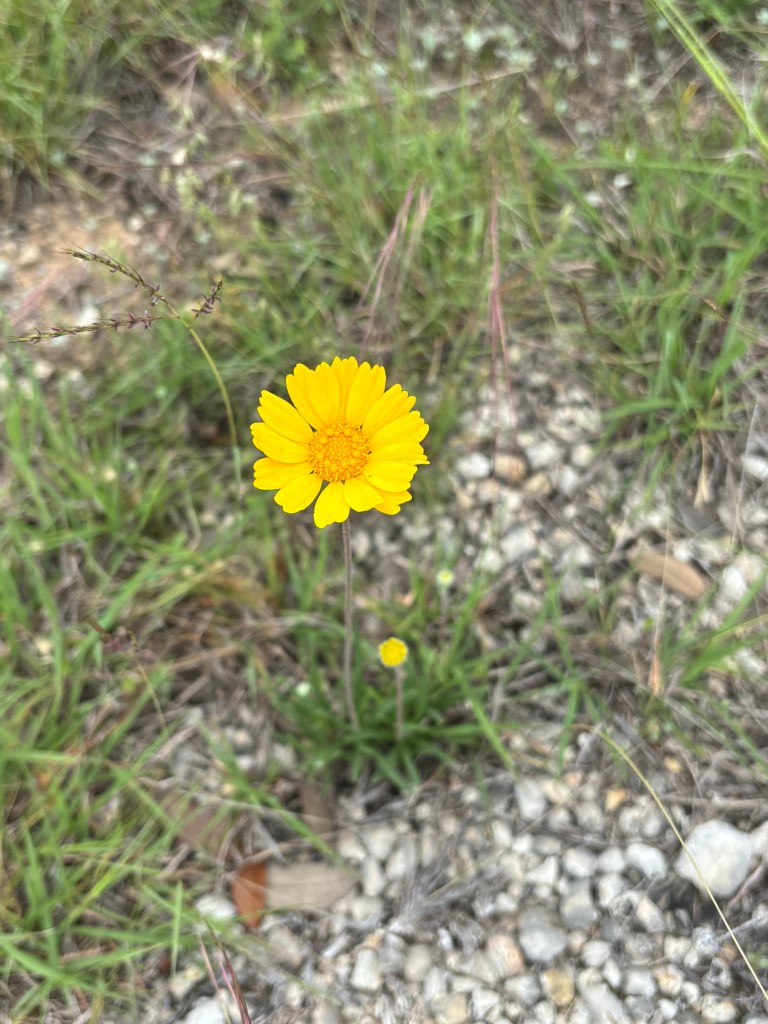
Not enough rain fell this year to allow the brilliant cerulean fields of Hill Country bluebonnets we usually expect, but the hardy lupines are busy making seedpods. “Maybe next year,” they say. Now instead we have the bright yellow coreopsis lanceolata, nodding their heads with any breeze,
the wine-cups with their indescribable color—a member of the mallow family, not quite fuchsia, not maroon, just—heart-stopping,

the milkweed flower globes beloved of monarch butter-flies, and others. Heaven includes a few prairie celestials, magically opening in early in the afternoon, then vanishing by dusk.

Also, “Sweet Mademoiselle,” planted a couple of years ago, and who has never bloomed, produced her first rose!

Meanwhile, the ever-interloping cactus hope to assuage my fury at them (remember those secretly spreading roots and the huge basal “plates” that help the Cactus Conspiracy spread?) by popping open their yellow flowers. I am not fooled. I’ll continue to battle them with shovel and hoe. And a picker-upper.

Now for some Hill Country facts.

BIG CATS?  Just in case you thought the animal that appears in my mystery Ghost Cat was, perhaps, unrealistic? Over-the-top? Mere fantasy? Couldn’t have played a part at beginning and end? Not so! https://www.statesman.com/story/news/state/2025/04/21/mountain-lion-san-marcos-trail-texas-sightings/83194256007/

See? Perfectly possible. It’s still wild out here in the Hill Country, even as suburbs press upon us. At dusk I often find myself glancing at the edge of the drop-off behind the house, wondering if I’ll see a pair of ears. You can say mountain lion, puma, cougar…they’re secretive, strong, and active in the spring.

But the big cat I once saw on Bell Springs Road west of here was likely a large bobcat. I was alone, driving home from the post office. Up ahead a golden vision, spotted, walked slowly to the edge of the asphalt. I stopped. The cat stood, gazed at me, and after a breathless (for me) interval, gracefully turned and vanished through a fence into thick cedar. A magical moment. Every time I drive that road, I hold my breath, longing for one more sighting of something looking like this:

https://images.app.goo.gl/K9VMv8bW92CpoSacA

ANCIENT BONES? I wrote about old bones in my Ghost Bones (2024)—and now have learned that our Hays County police deal with ancient bones more often than you’d think. One resident recently called to report she’d found a skull in her firepit. The skull, with its lower jaw present, was obviously fairly old, but in an unexplained death Hays County is not permitted to send a body to the Travis County Medical Examiner without including the name of the person whose skull it is. (Hays County doesn’t have its own medical examiner.) So this skull traveled instead to Texas State anthropologists who reported, after testing, that the skull apparently belonged to a long, long-ago teenager who’d gone through hard times, as was evident from the “enamel lines” (a bit like tree rings) in the teeth.

But how it wound up in that firepit? So far as I know, that’s still a mystery. We forget—until reminded by a skull in a firepit—how long humans have roamed these hills, drawn by hunger and thirst to spring water and the hunt for food.

We also forget the age and history of this landscape. Some trees have sheltered native Americans, deer, and buffalo. The Columbus Live Oak near the Colorado River in Columbus is estimated to be over 500 years old. Others may be as old as 1,000 years.

https://tfsweb.tamu.edu/websites/FamousTreesOfTexas/TreeLayout.aspx?pageid=26882https://goodcalculators.com/tree-age-calculator/

I revere the live oak in our front yard as if it were a beloved ancient relative and a symbol of stability and the power of trees. If anything were to happen to it—woe! I tried to estimate its age—using the calculator instruction to measure girth in inches at 4.5 feet, divide by pi, then multiply by a “growth factor” of 4, which gave me 127 years old. Perhaps this tree was a sapling in 1900, before either World War, before the Viet Nam war, before our current fraught politics. On a nearby hill there’s an ancient patch of even bigger live oaks. Perhaps those particular oaks depend on the odd little ribbon of wet white clay that lies about five feet underground and has been there—who knows how long. But the feeling of walking in beneath these old live oaks can confer a sense of being in the protection of one’s elders.

So, welcome to the Hill Country in spring—southeasterly winds from the Gulf, blowing the flowers back and forth; reasonably moderate temperatures; fields and trees as green as green, as far as you can see. At the bird feeder, more color! Purple house finch, yellow-throated vireo, lesser goldfinch with brilliant gold breasts, vermilion cardinals, black-crested titmouse, white-winged dove—and the shy and tiny, but utterly gorgeous, painted bunting. (Reportedly it loves millet.) They provide not just color but music, from the titmouse, the tiny but high-volume Carolina wren, plaintive doves, whistling cardinals, and, at night, chuck-will’s-widow.

Not for long, of course. In winter ice can wreak havoc on trees and people. Summer sun? Scorching. Autumn? Nothing like the colors of New England, but hey—the sumac turns red. So welcome, Spring, with your bluebonnets and live oaks, with bird music and color, and with your reminder of the power and beauty of nature!

***

Progress report: madly working on Book 10 of the Alice MacDonald Greer Mystery series, set in the Hill Country. Have ordered “Forest Bathing” by Dr. Qing Li. Would enjoy hearing what you all are reading too, and any reports of “forest bathing”!


Helen Currie Foster lives and writes the Alice MacDonald Greer Mystery series north of Dripping Springs, Texas, loosely supervised by three burros. She’s drawn to the compelling landscape and quirky characters of the Texas Hill Country. She remains deeply curious about our human history and how, uninvited, the past keeps crashing the party.

Follow Helen at http://www.helencurriefoster.com.

CATHOLICISM, THE MUNDANE AND THE PROFOUND.

By Francine Paino, a.k.a. F. Della Notte

Monday, April 21, 2025. “Jorge Bergoglio,” the Camerlengo tapped Jorge’s forehead gently with a silver hammer and repeated his birth name three times. The Camerlengo received no response and declared Pope Francis, the 266th successor to Peter, dead.

Of course, in today’s world, medical devices inform the state of man’s being, but the Catholic Church retains many of its rituals, and this is one. After declaring Pope Francis deceased, his ring was taken and destroyed using a special hammer to ensure it could not be stolen and its seal reused—a practical as well as ceremonial action.

The world is aware that the leader of 1.4 billion Catholics is dead, and Peter’s seat is empty until a new Pope is elected by the College of Cardinals. The world will observe the beloved rituals and ceremonies of the highest levels of clergy in the Catholic Church, and perhaps at this time, it is fitting to observe the lives of those of us who live the everyday, less exalted existences. Enter author Jon Hassler.

Catholicism, love it or hate it, is filled with traditions. Even today, after so many of the rules, ceremonies, and rites have been watered down, Hassler shows how Catholics are still impacted by their faith and how the changes have been received or rejected. He infuses his characters with insights and the deeper longings of our souls, to be respected, needed, loved, and part of a community. Being Catholic, Hassler writes with great authority about the perspectives and outlooks of this group of fictitious Catholics in the fictitious town of Staggerford, Minnesota. And, of course, non-Catholics will recognize and relate to these people. But why do we read fiction?

We read fiction to escape. Great adventures, mysteries, romance, and Sci-fi. But why read a book about a cast of characters whose lives are nothing special? Lives like our own, possibly? One can read these books and identify with different characters, their likes, dislikes, and situations. The progressive, touchy-feely nun, Sister Judy Juba, her obnoxious but elderly father. He wants a wife, but not for companionship as much as someone to care for him. Janet, Randy, and their young children. Father Finn and French, the Vietnam veteran with lingering PTSD, Who are these people? They are us!

Like sleepwalkers, we often move through the repetitive routines of life with our eyes half open or sometimes closed, as do the characters in Hassler’s books. In A Green Journey, we are introduced to his small town and its residents as they work their way through days of routine, nothing-special tasks. They’re not Hollywood stars, singers, or men and women of great wealth or political power. What this core group has in common is they are all influenced by the rules and requirements of being Catholic, and they are influenced by a steadfast, and still devout Catholic heroine, Agatha McGee.

Agatha is a crusty, disciplined disciplinarian and an ‘old maid’ who wants the best for everyone. She’d taught most of them over decades in St. Isadore’s elementary school. Agatha is also an old-fashioned Catholic who voluntarily observes rules that had been relaxed by the Second Vatican Council, like not eating meat on Friday.

While she does her best not to become despondent over the changes in the church, the end of her teaching career, and her aloneness without a husband or children, she involves herself in the lives of other residents of Staggerford, including her dearest friend, Lillian Kite, Lillian’s daughter Imogene, Father Finn, the pastor at St. Isadore, and a host of others. They all slog through life’s ups and downs with Agatha’s advice and assistance – or interference, depending on the point of view. While doing her best to help her neighbors, Agatha begins an innocent long-distance pen-pal relationship with James O’Hannon, a kindred spirit, in Ireland. She pours out her heart and the troubles and opinions of the community to him. After five years and a mutual growing affection, she can travel to Ireland to meet him. That trip holds great surprises for our heroine and James O’Hannon.

In the second book, Dear James, Agatha is back in Staggerford after her trip to Ireland and continues to respond to James’s letters but doesn’t mail them. Instead, she saves his in her desk drawer, unsure if she will ever fully reestablish their communications. After Thanksgiving, Father Finn invites her to join a pilgrimage to Rome with him and his brother, a college professor. There, she reconnects with James. As they work through what their relationship can and cannot be, at home, in Staggerford, Lillian’s spiteful daughter, Imogene, invites herself into Agatha’s house, searches it and finds James’s letters. Imogine reads them and is furious by what Agatha wrote. She takes an evil delight in spreading the news that Agatha has been sharing unflattering gossip about the townspeople. Upon her return from Rome, Agatha is greeted by a chill worthy of the deepest Minnesota freeze. How will they rise above their hostilities? Can they come together again?

Hassler was a gifted writer whose ability to infuse what we’d consider the mundane with deep insights into the greater, profound life that each of us contains is brilliant. As no two people on Earth have the same fingerprint, no two have identical soul prints. And therein, we find the truer meanings of the small, seemingly commonplace things in life.   

A New Woman is book three of the Staggerford Series. I look forward to reading about the later phases of Agatha’s 88-year life.

Until next time, Happy Reading.

The Upside of Resistance

 Productive Procrastination for Creatives

Most writers battle resistance from time to time, and it comes in many forms. Maybe you’re working on a project with a looming deadline, which is the perfect time to clean your kitchen.

Just ask Agatha Christie.

“The best time for planning a book is when you’re doing the dishes.”—Agatha Christie

I realize I’m bending her quote to serve my purposes, but who am I to argue with greatness?

© agathachristie.com

My most recent battle with resistance happened yesterday. After being away from a project too long due to other writing deadlines, I struggled to find my groove, which culminated in my spending nine hours trying to get my arms around a manuscript. My characters refused to behave, and a section of the second act sagged like a neglected hundred-year roof. The final pin dropped in the form of my losing several thousand words due to some sort of file syncing error. I’d spent all day trying to nail Jello to the wall and wondering why it refused to stick. 

I called my sister-in-law, who sagely suggested I needed to step away from my computer. Get some fresh air, go for a walk. I felt a bit better after but still defeated. I spent the rest of the evening with the gritty dust of failure stuck to my skin. I then reminded myself that this, too, is part of the process. The only way out is through. Tomorrow is another day.

I decided to start this morning with some writer support. After a two mile walk while listening to Brandon Sanderson discuss writing with Tim Ferris, I then read J.T. Ellison’s Substack on resistance. There was something about listening to other authors discuss their craft and the struggles that come with it that helped me refocus with a fresh perspective (and an attitude adjustment, which was sorely needed. I was very salty).

If you’re struggling with any sort of creative project, consider taking respite by listening to other creatives discuss how they do their thing.  Here are a few of my favorites:

The Tim Ferriss Show: Episode #794: Brandon Sanderson on Building a Fiction Empire… 

Buckle up, loves, because this episode is 3.5 hours long. It took me several walks and cleaning sessions to get through it, but I promise it’s jam packed with some fantastic advice and discussion related to both the art and business of writing. Few writers have accomplished what Brandon has while also so freely sharing his expertise with others.  

https://www.youtube.com/watch?v=5zzzjLKuFZA

Work Life with Adam Grant: Your Insecurities Aren’t What You Think They Are

Adam Grant is an organizational psychologist with a curiosity superpower that translates into countless benefits for his audience.  His WorkLife podcast is a regular listen in my feed. This episode is also how I found Taylor Tomlinson, which some might think is a strange way to discover a comedian.  Their discussion about how to handle insecurities when your job is centered largely on external feedback and validation (hello, writers!) is one that you may listen to more than once. 

https://podcasts.apple.com/us/podcast/worklife-with-adam-grant/id1346314086?i=1000523780269

J.T. Ellison Substack: The Creative Edge

If you’re a Substack fan, I highly recommend giving J.T Ellison’s newsletter a read. She gives us an inside look at her life as a bestselling author juggling multiple projects for both traditional publishers as well as her own imprint. Her advice is practical and specific, and she mixes in a generous amount of empathy. Here’s the post that pulled me out of my latest bout of writing resistance.

https://jtellison.substack.com/p/interim-step-two-facing-down-resistance

#AmWriting: Substack and Podcast

The author collective of the #AmWriting enterprise deliver some of the best stories, guidance, and interviews related to the business and craft of writing. Regardless of genre or publishing preference, they have you covered.  Their Substack is well organized and offers tons of shovels to help you dig yourself out of any writing hole you currently find yourself stuck in. 

https://amwriting.substack.com

James Clear: Atomic Habits and Newsletter

As someone who receives far too emails, James Clear’s newsletter is the rare one that I make sure to read as soon as it hits my inbox.  His 3-2-1 format (three ideas, two quotes and one question to consider) are thoughtfully considered. Every issue provides a valuable takeaway, and his recent Master Class covers the concepts he outlines in his mega-bestseller Atomic Habits.  Here’s what he shares with us about resistance:

“If you feel resistance before you begin, it’s usually procrastination and you need to get started.  If you feel resistance after you begin, it’s usually feedback and you need to make adjustments.”

Jiro Dreams of Sushi

Jiro Ono is an 85-year-old sushi chef and proprietor of Sukiyabashi Jiro, a 10-seat restaurant located in a Tokyo subway station. Some of the top critics believe he is the world’s greatest sushi chef. This documentary follows his passion for continued mastery even at what he sees as the final years of his career.  “A thoughtful and elegant mediation on work, family and the art of perfection, chronicling Jiro’s life as both an unparalleled success in the culinary world, and a loving yet complicated father.”

I discovered this documentary after my last visit to Japan and was moved by both the constant pursuit of mastery as well as the price it exacts on those closest to him.

I’d like to leave you with a quote that I revisit so often that I should have it tattooed on my forehead. 

“If I waited for perfection, I’d never write a word.”—Margaret Atwood

The world needs your stories more than ever, so I hope that if you’re battling resistance, you’ll find some support from the creative community. Storytelling, at its heart, should be something we enjoy, and if it isn’t bringing that to you right now, I hope it soon returns. And when it does, readers will be waiting for you.

–Laura Oles (https://lauraoles.com) is the award-winning author of the Jamie Rush mystery series. Her debut mystery, Daughters of Bad Men, was an Agatha nominee, a Claymore Award finalist, and a Writers’ League of Texas Award finalist. Depths of Deceit, her second novel, was named Best Mystery by Indies Today. Her novella, Last Call, won the Silver Falchion award. Her work has appeared in crime fiction anthologies, consumer magazines and business publications. She lives in the Texas Hill Country with her family.