I took my grandson to Barnes and Noble yesterday. When we got there, I realized I’d forgotten to take his mask.
“Uh, oh,” he said, looking forlorn. “Do we have to go back, YaYa?”
I reached into the bottomless pit, called my purse, and pulled out the extra mask I always carry. “No problem, darling. I always have extra.” But it was precisely the same as the one I wear. Hmmm. What to do? I smoothed the masks out on my lap.
“See that little mark?” I asked, pointing to one.
“Yes. Is that one for me?” he asked, hopefully.
“No, my dear. That mark is from my lipstick. You’ll wear the other.”
So, into B & N we went. He had a great time looking through toys (educational only—YaYa’s policy) and books for Kindergarteners.
I, on the other hand, puffed into my mask, fogged my glasses, and whenever I felt no one could see me, I cheated. I lifted the thing off my face for a couple of breaths of fresh air! After all, I’d rather not be treated worse than a murderer or rapist because I need some oxygen along with the C02 I’m breathing by wearing the mask.
Don’t get me wrong, I appreciate the reason and basically agree that wearing masks is at least some help against ALL viruses, not just COVID. It’s not a bad policy if uncomfortable and lipstick-smearing. I learned during the great toilet-paper chase, not to wear lipstick under the mask.
Early on, I was also using disposable masks. I knew that paper made incinerated garbage burn hotter, and I wondered how all this extra fabric and paper would impact the environment. It didn’t take long to find an answer about the potential problems for the environment at https://www.energylivenews.com/2020/03/17/coronavirus-face-masks-could-have-a-devastating-effect-on-the-environment/
While I am not an environmental warrior, I was the first in my family to question the wisdom of the public using disposables. Those should be reserved for our courageous nurses, doctors, and workers who actually need them to preserve their own health while on the job. Thus, by the end of March, everyone in my family, kids, kids-by-marriage, and grandkids have switched to washable masks. We disinfect and launder them at the end of each day. Kudos to me!!! LOL
Of course, I can’t take much credit, since I have also developed some bad habits in this new masked and locked down society. As an example, here I am, today, awake, writing, and taking care of business since four a.m.—no praise here – just my body clock- I haven’t yet bothered to comb my hair, wash my face, or get into street clothes. Sitting in front of a computer screen absolves me of the responsibility to present a decent face to the world – or does it? Or should it? I say no, but do it anyway, except for Zoom meetings, when I’m forced to at least wear some makeup.
So, as my grandson browsed, I looked around at all the masked people. Some wore ear-loop face masks, others wore the type with elastic bands that wrap around the head, while others wore the pull-up masks.
How different from our pre-COVID lives. We would have reacted quite differently to anyone walking into high-value targets for robbery like banks, restaurants, jewelry stores, and movie theaters with face coverings. Also in our pre-COVID life, we were encouraged to be environmentally responsible and bring our own reusable bags to stores and supermarkets. Now, if we do, the cashiers tell us before beginning to scan that we must pack the bags ourselves. This suits me anyway. I prefer doing it myself. I want ‘like items’ bagged together, which makes unpacking faster and more efficient.
And now, the social distancing. No more hugs for friends and relatives. That stinks, and I refuse not to hug and kiss my grandchildren, but I have learned to kiss their heads on top, not their faces. Can’t live without my hugs, but we hug with our faces turned away from one another—well, it’s better than nothing!
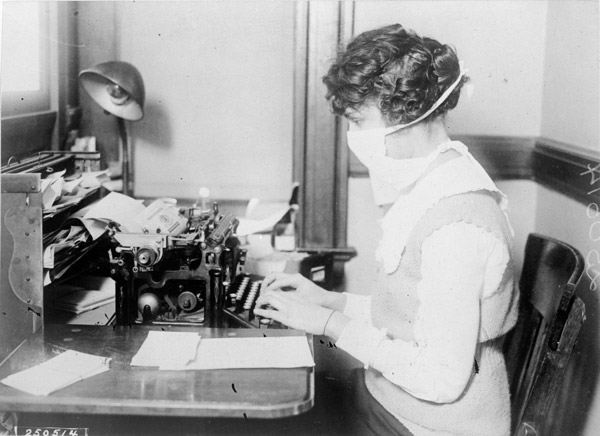
So, while I complain, grouse, have hissy fits over the whole thing, I remember how fortunate we are as history repeats itself. One-hundred-and-two years ago, the world suffered a pandemic called the “Spanish Flu, or the Spanish Lady,” even though it did not originate in Spain. 500-million people worldwide fell ill with this early variety of H1N1 and Avian Flu combined (as per CDC). In the U.S., 675,000 died, including those who are always most susceptible: young children and the elderly. The surprise in that pandemic was men and women in their primes became ill and died at alarming rates. At least we can be grateful that the young children and young adults seem to weather this COVID thing much better.
A-hundred years ago, there were no antibiotics, no pharmaceuticals to treat the virus, and they knew less about better hygiene. Although state and federal governments did close some schools and some businesses, most people had to leave their homes to earn a living or leave their family’s to starve.
So what have I learned from all of this? First off, back to good hygiene, people. For years domestic chores like house cleaning weren’t high on the intellectual list of essential tasks. How much better might people have fared in 1918 if they’d had the cleaning products we have today? Perhaps we should resurrect the saying, “Cleanliness is next to Godliness.”
And of course, masks. They are not foolproof, but they are valuable tools and if wearing them was good enough for my great-grandparents, I guess it’s more than good enough for me. 
As for my bad habits, when COVID-19 ends, I will once again learn to groom early, get my face on, and leave sufficient travel time for appointments. Meanwhile, I can jump on to virtual meetings without contending with traffic, or worrying about what I’m wearing. While all of this lasts, I’ll spend less on lipsticks and face powder, less on clothes, but have more to spend on books, and I’ll also pay attention to many of the unique ways we’ve learned to cope with this stinking virus.  Stay safe, and stay masked!

 Says Sarah Perry in the Irish Times, “Every novelist since has ground their teeth in envy: here is all the enchantment of a child’s story, with an irresistible melancholy hung about it.”







 Austin Mystery Writers