When Tech Takes Over

-Laura Oles

A few years ago, Microsoft released a study that claimed the average American had the attention span of a goldfish.  

Eight seconds. 

I can relate.

While this study has been hotly debated–some sources claim we are simply becoming more adept at filtering out unimportant content designed to grab out attention–I remain undecided. Some days I’m Dory from Finding Nemo. “Just keep swimming, just keep swimming…ooh, what’s that? A new project?”

And I’m off on a tangent.

This has become particularly more challenging now that summer is here and our kids have no fixed daily schedule.  I love this part of parenthood–my kids are older now and time is fleeting–but I also realize that I have to carve out a set schedule even though others are coming in and out all day.  Working from home is a wonderful gift but also brings its own challenges.

And don’t get me started on the time suck that is social media. I know some truly productive people who are on Facebook/Instagram/Twitter all the time, and I marvel at how they manage it all.

I’m not one of those people.  
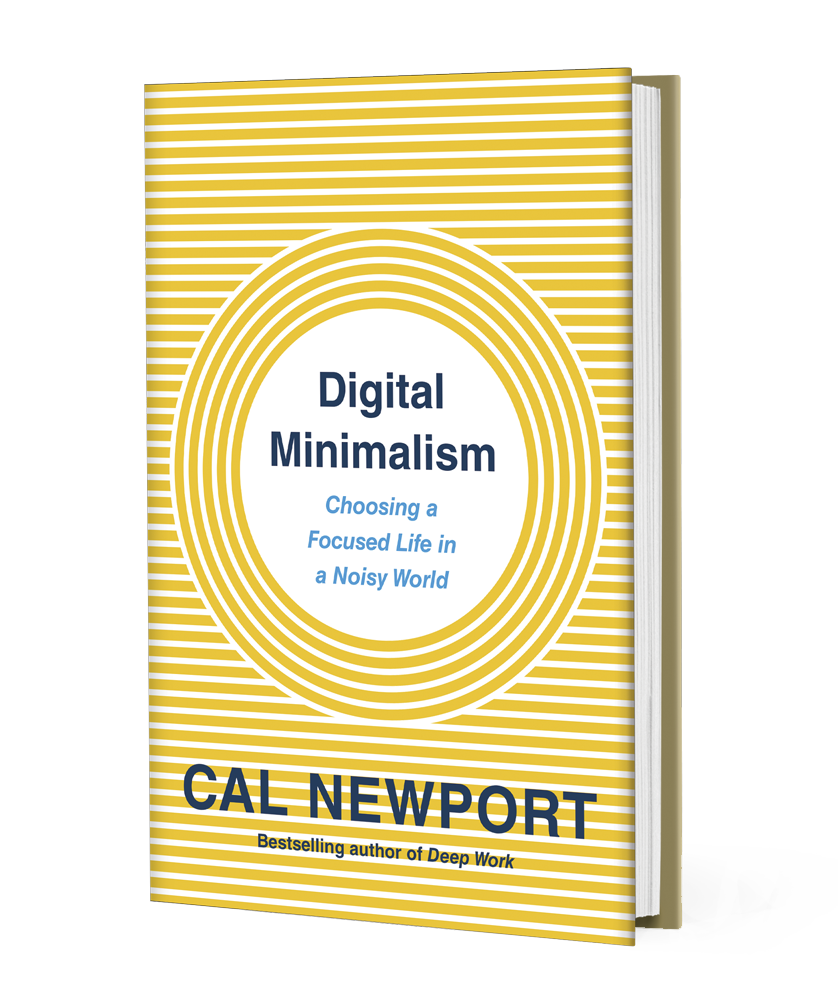
So, as someone who was in search of solutions, I was thrilled to come across Cal Newport’s latest book titled Digital Minimalism.  I had read his previous book, Deep Work, and found some very compelling arguments for ignoring most things that demand our attention in order to accomplish our top priorities.  Cal Newport is an associate professor of computer science at Georgetown University, but he isn’t on social media.  He’s a prolific author and an example of what one can accomplish when treating our attention and time as our most valuable resources.  One of Newport’s most powerful contentions is that so few people possess the ability to focus on a single task for long periods of time that this skill will soon become a huge competitive advantage. 

I decided to experiment with some of the lessons I learned to see which ones, if any, might help improve my focus and reclaim some lost time.  Here are a few that are working for me:

No Morning Social Media:  With the exception of my publisher’s FB group and a writers’ sprint thread, I try not to be on social media unless there is a specific reason (book promotions, etc).  Working from home can be fraught with distractions, but I feel this is one thing I can control.  This rule helps me turn my attention to my daily priorities sooner instead of squandering minutes and energy on social media procrastination.  

Scheduled Email:  Having my email accessible on my phone has been a mixed blessing.  I can quickly respond to requests and inquiries, but then again, like social media, before long I’m down a rabbit hole of other people’s priorities. I now check in three times a day–early morning, lunch, and end of day–and this seems to work well.  If there’s an urgent concern, that’s usually when I get a phone call. People know how to reach me if needed. 

OSX Daily

Do Not Disturb is Your Friend:  Did you know that studies show that we check our phones several times per hour even when we aren’t receiving notifications?  And when our phones are blowing up with non-critical messages and demands for our attention, it takes us 20 minutes to refocus completely on the task at hand? There are so many ways for technology to intrude that it has required me to rethink my constant accessibility.  I now put my phone on Do Not Disturb for certain hours in the day when I know I will need uninterrupted time.  That doesn’t mean my time remains completely uninterrupted, but at least I’ve narrowed down the ways in which my time gets fractured into smaller segments.

I realized that I sometimes allow technology to determine which priorities receive my attention rather than using technology first and foremost for my own benefit in pursuit of my goals.  Pushing my correspondence and social media to the late afternoons/evenings has helped open my creativity and allowed the space my mind needs to work out plot issues and character motivations.  By not filling in small bits of time with other distractions, I’m returning to those earlier days when our minds were allowed to wander and ponder.  

I still fall off track now and then–usually, when I’m struggling with a particular aspect of a writing project–but I now catch myself more quickly and return to the task at hand.  Being more mindful of my attention has also helped me better identify why I’m procrastinating in a certain situation.  Once I can name it, I can figure out how to fix it.  I still fall short sometimes, and that’s okay.  Small improvements can mean big results over the long term. Not perfect, but better.  

I’ll take better. 

Well-Rounded Thrillers? Naw…Really?

By K.P. Gresham

Sara Paretsky’s letter to the editor of the New York Times (June 14, 2019) has created quite a stir in the mystery writing community. This actually surprised me a little.

Sara Paretsky by Mark Coggins, licensed under CC BY-2.0, via Wikipedia.

For years the majority of U.S. publishers, editors and booksellers have preferred male-authored novels in the mystery thriller genre. Let’s define our terms here. Hard thrillers are generally male-oriented in intended audience, protagonist sex, and author generation while cozy mysteries are intellectually gender-neutral and character- and puzzle-inclined) The New York Times put out an op-ed that said female authors are finally breaking into this male-dominated genre.

Ms. Paretsky’s point is that women have been writing thrillers for decades.  . . .

Click here to read the rest of the post at Ink-Stained Wretches.

Shattering a Vase


it was like taking a vase and setting it down so hard it shatters…

~  Tracy Chevalier

When I taught secondary English, grading essays was my least favorite task. I was happy to read them, but assigning letter grades? I hated that.

I hated judging. I hated trying to determine the difference between a B and an A, or, worse, between a B-plus and an A-minus.

But the worst–the part that made me want to moan like the Ghost of Hamlet’s father, “Oh, horrible, oh, horrible, most horrible!”–was listening to students who thought their work merited higher grades: “But I worked so harrrrrrrd.

Some had watched classmates complete an entire assignment during a lull in history class and then score A’s. It wasn’t fair.

Harrrrrrrrrrd” was my signal to say that no, it didn’t seem fair, but that good writing comes from more than just time sheets and sweat. It’s the words on the page that matter. 

Now, to my dismay, I sometimes find myself slipping into student mode. For example, when I submit a chapter to my critique group, or an agent, or a publisher, or a reviewer, or a family member, and they find fault or don’t mention my genius, I have to restrain myself from wailing, But I worked so harrrrrrrd…

Each time it happens, I pull out the old talk about time sheets and sweat. I add that whingeing is the hallmark of the amateur.

And I meditate upon Tracy Chevalier.

Chevalier wrote the critically acclaimed historical novel Girl with a Pearl Earring. Her next (third) novel began as a draft written in third person, with small sections in first-person voices of children. The finished manuscript was a disappointment.

When I reread the first draft, she says,  I cried at the end. It was boring, dead weight, terrible. Then I looked it over and thought, there’s nothing wrong with the story except the way it’s told.

She found the solution in another contemporary novel:

I had the idea when, just as I was finishing the first draft in third person, I read Barbara Kingsolver’s The Poisonwood Bible, which uses five different voices beautifully. It’s a wonderful book, using multiple voices very successfully, and I thought, “Oh, that’s an interesting technique, I wonder if I should take the kids’ voices I’ve already written and have the three of them tell it.” It just felt right.

The revision was published as Falling Angels, a novel about a young wife and mother struggling to survive in the rigid, but rapidly changing, social structure of Edwardian England. The book is written in first person, from twelve perspectives, in twelve distinctive voices. It’s exquisite.

I came across Chevalier’s account when I was just beginning to write fiction and had become obsessed with the work. Writing an entire manuscript, setting it aside, starting all over—it had to be pure drudgery. I couldn’t imagine putting myself through that. 

Recently, though, I reread the article and a different passage caught my attention—Chevalier’s description of the rewrite:

I took the draft, and it was like taking a vase and setting it down so hard it shatters, then putting the pieces back together in a different way. I rewrote the whole thing in first person with all these different voices.

Chevalier doesn’t describe drudgery. Shattering a vase, putting the pieces back together to make something new—that’s a picture of creation, of the excitement and the pleasure and the beauty that accompany it.

I love Tracy Chevalier’s novels and admire her talent. I’m grateful to her for sharing publicly how Falling Angels made its way into print, for reminding me that hard work and drudgery aren’t synonymous, for implying it’s okay to cry over a bad draft, and that perceived failure can turn into success, and for showing that the act of writing affords as much pleasure as the spirit is willing to embrace.

And—for tacitly suggesting that no one really needs to hear me whinge about how harrrrrrrrd I work.

It’s the words on the page that matter.

*****

Confession: I love Falling Angels so much that during library duty one Saturday morning, I was so intent on finishing the book—racing toward the climax—that I unlocked the front doors but left the lights in the reading room off, and spent the next ninety minutes parked behind the circulation desk, reading and hoping no one would walk in and want something. I’m not proud of what I did, but patrons didn’t seem to notice anything different, and I finished the book.

*****
This post appeared on the Austin Mystery Writers blog on September 2, 2015.
Information about Tracy Chevalier comes from Fiction Writers Review.

***
Image of Hamlet and his father’s ghost by Henry Fuseli via Wikipedia [Public domain]
Book covers via Amazon.com

***

M.K. Waller’s short stories appear in AMW’s crime fiction anthologies Murder on Wheels and Lone Star Lawless, and online at Mysterical-E. She blogs at Telling the Truth, Mainly.

Building Character Profiles While Fighting the Battle of the Bulge

Francine Paino

The Battle of the Bulge, (December 16, 1944–January 16, 1945), was the last significant German effort to split the allies at the Ardenne Forest….

Oops. Sorry. I wrote this at 4:30 a.m. I hadn’t had enough coffee.  

Although the Battle of the Bulge or the Ardenne Counter-offensive was a major military campaign and an important part of WW II, that’s not the bulge that concerns me.

We writers sit in front of computers or writing pads, or typewriters (LOL) for hours each day trying to convert into words the stories playing like movie reels in our brains to entertain others. We continue to study the craft – necessary to improve as writers – also done sitting—thus, we don’t usually get the exercise we need for good physical conditioning and creative thinking.

 Stanford University study:  https://news.stanford.edu/2014/04/24/walking-vs-sitting-042414/

Another interesting article, among many, claims that scientists have now discovered that exercising regularly, in any manner you choose, such as bike riding or walking, do improve creative thought.  

https://www.telegraph.co.uk/news/science/science-news/10491702/Lacking-inspiration-Exercise-found-to-boost-creativity.html

However, a word of caution. Exercise cannot become another tool for the number one writers’ disease: Procrastination!

So, what to do?

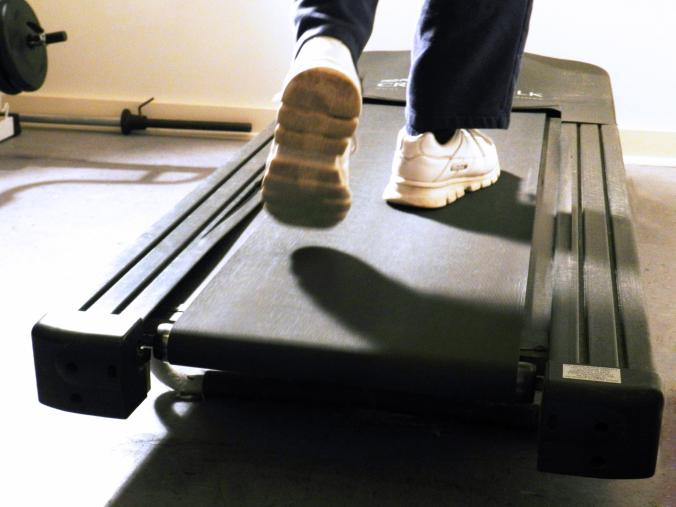
For myself, now that my metabolism has deserted me, I feel the need to get on that treadmill—which I hate—and force myself to move along at a respectable pace, or spend 15 hard minutes twice a day with an exercise hoop – which I hate even more.

I’ve tried too many forms of physical exercise to list, but after a long, long story, ‘I’ve decided the treadmill suits me best because it allows me to study different characters in my collection of recorded movies, while meeting the demands of a workout.

Thus, while I’m trying (a child’s term) to take off some of the bulges in places that lumps and bumps don’t belong, I’m doing some passive character analysis and development too.

Among my favorites are the British ladies in Tea With Mussolini, set in 1930’s Florence, Italy. Maggie Smith is the elitist, widow of a British Ambassador, which she never lets anyone forget. Dame Judy Dench, an artist of limited talents devotes herself to helping restore artworks in Italian churches, and Dame Joan Plowright plays an upstanding British lady who works for an Italian reprobate dealing with British imports. ‘Plowright’s portrayal of Mary Wallace’s character inspired some of the characteristics of my Mrs. B. in I’m Going to Kill that Cat.

Add to this list of fascinating characters….Cher. She portrays a free-spirited, wealthy, boisterous and good-hearted American Jewish actress who finds herself deceived by an Italian-Nazi operative.

Another movie favorite is Larry Crowne, a very modern-day situation. Tom Hanks portrays the affable, title character in a story about how life can throw more curve-balls than Sandy Koufax.

Larry Crowne must change or perish. Hanks portrays his character with a constant optimism, even in the face of hard-knocks and fears; Crowne adapts. As he meets new challenges in his life, he also meets an embittered professor, played by Julia Roberts. 

Watching these and other movie characters change and grow in the face of conflict, and painful circumstances provide insights that help me show growth and development for those who live in my head and in my stories.

So, now that I’ve shared one of my methods of adapting exercise to the craft while fighting the writer’s battle of the bulge, I hope I’ve provided some inspiration. It certainly can’t hurt writers to stimulate the circulation of blood to the brain.

Moreover, there is an additional benefit that I’ve not seen discussed: the reduction of guilt. Guilt for not exercising and guilt for not writing in order to exercise.

So, get out there. Walk. Look at nature. Indoors, ride a stationary bike or jog on a treadmill while watching movies or reading books. Work your body and your creativity.

Happy writing!

Interview With Terry Shames: Discussing A Risky Undertaking for Loretta Singletary, and More

Terry Shames

Tonight (June 3) Terry Shames will be at Book People along with SC Perkins. Don’t miss it!

Terry Shames was kind enough to agree to an interview.

VPC: Thank you for letting me interview you. Tell us a little bit about Samuel Craddock and how he came to you as a character.

TS: I attended a workshop where one of the speakers gave an impassioned speech in which she said a writer needs to reach deep inside and find the story that only she can tell. I had heard that line before, but for some reason this time it resonated. I realized that I wanted to write a story set in the town where my grandparents lived when I was a child. I also wanted an older protagonist who was still vital. I was tired of reading crime fiction in which older characters were described in disparaging terms. I was very close to my grandfather, who was active into his “golden” years, and he seemed like the perfect model for my protagonist. So Samuel Craddock was born.
 
VPC: This is number 8 in the series, right? How is this book different from the previous books in the series?

TS: It’s probably a little lighter in tone than most of them. The last book, A Reckoning in the Back Country, was very grim, so I decided to step back a bit in this one—if you can call it light when one of your main recurring character is in harm’s way. In each book I focus on something of current social importance. I had read about the particular vulnerability of seniors going on dating sites—especially their economic vulnerability, and thought it was a perfect setup for Loretta to be in trouble.
 
VPC: Sounds funny and a little scary. I know you can’t share everything, but what can you tell us about your days working for the CIA?

TS: At this point, anything I did at the CIA is long past its “do not tell” date. I’ll share the thing that used to amuse me. I was tasked with reading incoming documents in my section and assigning security labels to them—secret, top secret, “eyes” only, etc. First of all, why they thought a 21-year-old should be in that job was odd. It was more or less boilerplate labeling, based on particular buzz codes, but still there was a certain amount of decision-making to be made. Second, the assessments were strictly set, so that I sometimes had to assign Top Secret Code Word labels to things I had read in the Washington Post the day before. That’s why when current political figures hyperventilate about people leaking top secret documents, I view that problem with a healthy grain of salt.
 
VPC: Thanks, good information to know. What is your typical writing day or week like?

TS:I would really prefer to write first thing in the morning, but I am dedicated to keeping physically fit, so every morning I work out either at the gym or at home. Then I go to my desk and fool around until I get anxious. (Fooling around includes reading the news, answering emails, updating my website, doing promo, checking in on social media etc.) Finally, when I’m antsy enough or when my stern voice kicks in, I get to work. Usually the actual writing time is not that long. But while I’m working, I am very focused and can pound out 2,000 words in a couple of hours. I think that’s because while I’m “fooling around” my lizard brain is working to figure out what I’m going to write when I finally get to it.
 
VPC: What do you do when you’ve hit a wall and can’t seem to solve a plot problem or when the words don’t want to come to you?

TS: This doesn’t happen often when I’m working on the Samuel
Craddock series. I don’t know why. I can only remember one time, when I was writing Dead Broke in Jarrett Creek, when I couldn’t figure out where I was going with a plot, so I just forged ahead without really getting a grip on it. I ended up having to excise and revise a lot of the last 20,000 words because I went on a tangent that didn’t work out. The book I’m working on now is much more difficult. I hit places where I simply don’t know what should happen next. When that happens, sometimes I will brainstorm, which consists of quickly writing down ten possible things that can happen. This usually gives me at least one idea. And sometimes I just write blather. What I mean is that I set up a conversation or do a lot of description that may not necessarily end up in the book but just gives me a sense of where everybody is in the book and what they’re up to. And one other thing I do is really think about what I want to accomplish, not just in the scene but in the book as a whole. That can help. And then….there’s the old, “write anything. ANYTHING. But just get some words down.” That can actually be very freeing.
 
VPC: What do you co to blow off steam?

TS: Exercise helps. But I also rant on Facebook, write letters to the NY Times or to members of Congress. I drink. I love to cook, so cooking a meal can feel very freeing. I love to watch basketball. I love to hang out with friends.
 
VPC: I’ve read some of your pieces in the NY Times and I was impressed! I understand that you lived in Italy for a while. What can you tell us about your time there? What was your favorite thing about your experience?

TS: We lived there in the early 1990s. My husband was doing some research with a scientist in Padua. We decided it would be fun to live in Florence while their collaboration was going on. It was a wonderful experience. I loved the art, the people, the beautiful countryside. We had great plans to see a lot of Italy, but mostly we took an opportunity to really get to know Florence. I hiked, went on excursions in the Chianti, explored in depth. Our son went to the fourth grade and part of fifth grade there, in an international school, so we met people from all over the world, and loved every minutes of it. When we go back on visits, I feel as if I’ve gone home.

VPC: Sounds wonderful!
Thank you so much for doing this interview. I hope that we’ve introduced some new people to you and your work.

For more information about Terry Shames and her books, you can follow her at https://www.terryshames.com