It’s Not About You

once upon a timeWhile attending Malice Domestic in Bethesda, MD last month, I overheard a small group of authors gathered in the hotel bar discussing the issue of whether family members or friends thought a character was actually a portrayal of them. It seemed each had a story to share. One author’s sister felt a character was based on her. The author, however, stated the two–the sister and the character in question–had very little in common. The sister had picked up on one particular behavior and, from that point, assumed the entire character was based on her. It caused a bit of a family kerfuffle.

A quick online query about the topic will reveal many writers discussing how someone–a loved one, a friend, a colleague– believes a character is based on her and is unhappy about it, even when the author assures her it just isn’t so.

That’s not to say that certain authors haven’t based characters on real people–it happens all the time and often the author will reveal that information outright. After all, Anne Lamott once wrote, “You own everything that happened to you. Tell your stories. If people wanted you to write warmly about them, they should have behaved better.” That said, this topic becomes further complicated when the book is a work of fiction and no intent to base a character on a real person was made.  So, what happens when someone in your circle believes a character–one with one or more negative traits– is based on her?

If the character is a benevolent superhero with skills that put all around her to shame, letting your aunt/sister/friend claim that character as a portrayal is no issue. Let her enjoy the idea. However, what if the character is difficult, angry or passive-aggressive? How does an author help those around her understand that it is indeed a work of fiction?

While I can’t speak about the experiences of other authors, as they are as vast and layered as the works in our genre, I can share my general thought process when writing fiction. If this post helps neutralize a heated conversation, I’m happy to help.

I tend to be drawn to the dynamics between people, to specific conversations, to behavior and to moments in time. I might take one particular spark–a discussion, an encounter–and run with it. The result may be a compilation of my own experiences with several people over a long period of time, and I find that my characters take those behaviors and use them for their own purposes. No one in any of my work represents any one person. However, one person may have traits from several people or have experiences from several people all wrapped up in that one person. That’s a pretty wide net. After all, each one of us can be angry, difficult, funny, sarcastic or rude at any given time. Each one of us may have experienced the shattering loss of a parent, the sharp tongue of a hostile work colleague, the exhaustion of a demanding career. It doesn’t mean a character with those traits or experiences is based on a real person.

Each writer brings to her work a culmination of experiences, heartbreaks, conversations and issues and those tiny threads are bound to weave themselves in the story somehow.

But not in the way others might believe.

My primary purpose is to encourage the reader to care about the characters and what happens to them. That is my goal. Creating characters based on real people isn’t part of my process.   I may appreciate how one friend handles difficult conversations while another friend’s compassion with animals makes me smile, but that doesn’t mean those same people show up in my work. The particular behavior or personality trait might but that is only because it belongs to the character. That’s where it ends.

Writers study the world around them, taking note of interactions and exchanges, tucking them away in the hopes they might be useful in a story one day.  What happens next is complete fiction, and isn’t that one of the best things about being a mystery writer?

–Laura Oles

How To Conduct A Masterful Story

by V.P. Chandler

Originally posted June 15, 2015

You know how some songs are more appealing than others? They just seem to have that “something” that people like. I think the same thing is true for books.

I’ve recently tried my hand at writing music, so I’ve been studying the structure of songs. The way the verses and chorus are laid out are comparable to poetry. Then one day I noticed that the music itself is similar to story structure. Even different types of songs can be compared to different genres. (All links provided are from “official” Youtube channels or websites.)

Typically most pop, rock, or standard music that we listen to follows a pattern:

Intro, Verse 1, Verse 2, Chorus, Verse 3 [Usually a variation of the tune], (Maybe Verse 4) Chorus [Maybe with a variation to change it up a bit.]

For instance, here’s Real Gone by Sheryl Crow

I love that song! The intro does exactly what it’s supposed to do. It sets the tone for the piece. The variations on the theme and the constant fast beat keep it from getting boring.

I think it’s like a lot of popular books out there. It’s got a good beat and the tempo doesn’t let up for the whole song. I think of thrillers that have constant action. A variation on theme helps to keep things interesting. Maybe like James Bond and his extra curricular activities? He’s still James Bond, just a variation on the spy theme.

But what about other songs, like maybe orchestral pieces? How do composers keep them interesting? Do they follow a pattern too? Is it similar to a story arc or story structure?

Breath and Life by Audiomachine.

The intro sets the mood. The pulsing beat keeps it moving. The melody plays then repeats. (Verse 1 and Verse 2) Then after a short change, the music grows and they vary the tune. It grows and grows with intensity, volume, and moves higher. It finally reaches the ultimate point. Then it dies off. The structure is not so much an arc, more like a wedge that just grows then drops off. Personally, I prefer a story to grow to almost the very end.

And here’s the part that absolutely fascinates me. Notice that while the singers and the main melody have long notes, there are always the underlying beats that keep it moving? I like to call this microtension. I believe I first heard the term from Donald Maas. http://absolutewrite.com/maas_fire_excerpt.html

Good writing, no matter what genre, has microtension to keep the story flowing. It’s what keeps your characters growing and interesting.

Here’s another song by Audiomachine called Equinox

While you listen to it, think about the pulsing under the long notes and feel how it grows. Now imagine your story or any story. Does it grow like this? Do your secondary characters highlight your antagonist and protagonist, like the chorus and instruments provide harmony? What is height of your story? I like the little tag at the end. It’s an echo of the theme. I think the best stories have a little scene at the end that sums up the journey, whatever it may have been. (I mean good grief! Don’t you want to read the story that fits this music?)

I can’t help myself. Here’s another called The Fire Within

And one last song. This isn’t as dramatic as the others. But I think it’s a perfect example of the relationship between a protagonist and an antagonist. The relationship of the two should mirror and echo each other. This is a relaxing song, like I said, not dramatic. But I love the echo of the piano and the harmony of the flute.

The Gift of Love by The O’Neill Brothers

So I’ll leave you with this. In the first words of your story, write an intro that gives your reader a taste of what’s to come. Set the melody. Support your story and characters with harmonies, and counter melodies. Don’t keep things the same. Grow by changing the key signature and keep the beat pulsing. Grow, grow, grow! Make it bigger! Give it a dramatic finale and end with a reflection, a bit of the original melody to remind the reader of the journey. Good luck. And if you have a favorite song that makes a perfect story, feel free to share with us in the comments! I’m always on the lookout for new music.

Links:

www.audiomachine.com

http://www.pianobrothers.com

2015 Reading Challenge

Wouldn’t it be great to have a list of every book you’ve ever read? An aunt of mine kept such a list.  We found it when she died at ninety. It would be a wonderful gift for a child, to give her a blank, lined notebook along with the idea of keeping such a list.

In January, I started writing down what I’ve read this year, and I’m curious to see whether I will read 100 books in 2015. Along the way, just for fun, I’ve already completed a reading challenge:

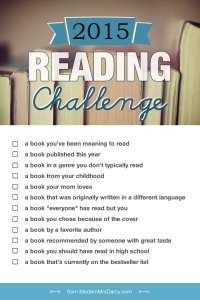
Modern Mrs. Darcy’s 2015 Reading Challenge

2015-Reading-Challenge

You’re supposed to read 12 books in each category–that’s a lot! I read one in each. My twelve books:

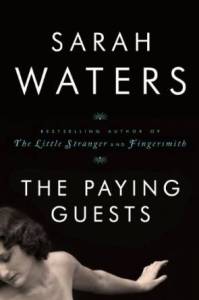
A BOOK I’VE BEEN MEANING TO READ: The Paying Guests, by Sarah Waters. She does not usually write in the murder/crime genre, but here she does. Loved it!

A BOOK PUBLISHED THIS YEAR: YOU, by Caroline Kepnes. I amended this category to “a book published within the last year.”

A BOOK IN A GENRE I DON’T TYPICALLY READ: The Battle for Saigon, a military history by Keith Nolan. I read it because I am writing up a friend’s experience living in Saigon during the 1960s and ‘70s. I glossed over the jargon, hardware and acronyms, of course. When he wrote about an NCOIC and three augmentees in a M113 APC with a .50-cal MG, I took this to be a bunch of guys in a truck with a big gun. I don’t like war, but this was by turns interesting, appalling, and exciting. Well researched, too. I thoroughly enjoyed it.

A BOOK FROM MY CHILDHOOD: I couldn’t think of a book from my childhood that I wanted to reread (Nancy Drew doesn’t work for me anymore), so I listed Winterdanceby Gary Paulson, because it’s such a great and perennial favorite of my inner child. It’s about sled dogs and the “fine madness” of running the Iditerod. Charming, wonderful read (especially if you’re foolish over dogs like me) (and out of 295 customer reviews, a whopping 255 are 5 stars–read this book).

winterdance

crackingrailwaybazaar

A BOOK MY MOTHER LOVES: The Sleep of Reason, by CP Snow. My mother didn’t love this book. I am not even sure she read it. She mentioned it in such a funny way that, fifty years later, I was curious enough to read it. Weird.

A BOOK ORIGINALLY WRITTEN IN A DIFFERENT LANGUAGE: The Devotion of Suspect X, by Keigo Higashino, a fabulously well-plotted murder mystery.

GOTpayingA BOOK “EVERYONE” BUT ME HAS READ: Ugh, do I have to? I bounced off a few of these—there’s a reason I haven’t read them—and finally settled on The Goldfinch, by Donna Tartt. This book will mess with your year-end total—it’s 800 pages long! A Pulitzer Prize winner with 21,000 Amazon reviews.

A BOOK I CHOSE BECAUSE OF THE COVER: Malice, also by Keigo Higashino.

A BOOK BY A FAVORITE AUTHOR: Last Train to Zona Verde, by Paul Theroux. This is a reprise of Dark Star Safari, which you should read instead. In fact, if you are not already a fan, start with The Great Railway Bazaar.

A BOOK RECOMMENDED BY SOMEONE WITH GREAT TASTE: Cracking India, by Bapsi Sidhwa.  Thanks for the recommendation, O you with great taste, Kathy Waller! I loved it.

A BOOK I SHOULD HAVE READ IN HIGH SCHOOL: Moby Dick. DNF. Once again.

A BOOK THAT IS CURRENTLY A BESTSELLER: The Girl on the Train, by Paula Hawkins. Great read. Inspiring that a mid-list author rolled the dice with a genre shift and hit the big-time!

Elizabeth BuhmannElizabeth Buhmann is the author of Lay Death at Her Door. An old murder comes unsolved when the man who was convicted of it is exonerated.

Wine-Dark Sea or Purple Ocean?

Jo Nesbo 005

hutto oct. 1 2014 023 (2)By Gale Albright

Are translators poets? In the séance of life, are they the disembodied spirits who speak not beyond the grave, but beyond the language barrier?

I’ve always had a problem reading translated works. The problem being I wouldn’t read them. I figured I just wouldn’t get anything worth while. To coin a phrase, I thought everything would be lost in translation.

I was wrong.

To begin with, think how much knowledge, beauty, and experience I was missing. If Europeans followed my example, I assume no German or Frenchman would have ever heard of Shakespeare. They would say “Who’s Hamlet?”

See, I was so wrong.

Without talented, inspired translator Robert Fitzgerald, how could we thrill to phrases such as “rosy-fingered dawn” or the “wine-dark sea” in Homer’s Odyssey?

Someone else might have said “the ocean which has a purple shade somewhat like Chianti,” or the “sun rose with little pink things reaching out like tentacles to the sky,” or some such.

And there’s another point. Just any old translator won’t do. Surely the translator, to capture the essence, the heart and soul, the very being of the language and feeling and evoke the right responses in readers in a totally different language and cultural context, must be an artist himself.

http://www.poetryfoundation.org/bio/robert-fitzgerald

And then there’s the slang, for heaven’s sake. Supposedly, Americans speak the same language as do the folk in the United Kingdom. But I had to stop watching Red Riding with one of my favorite actors, Sean Bean, because they might as well have been speaking Urdu, and I lost about 75 percent of the story. The same holds true for novels. They are full of local slang and colloquialisms. For example, Tana French writes in English and is a great writer, but her characters in the Dublin Murder Squad are always “taking the piss.” It’s not what it sounds like. From what I could gather, it means being teased or set up for a joke. So, suppose Tana French were not writing in English. Say, she was writing in Norwegian. And wrote down whatever the Norwegian police jargon for “taking the piss” is. Now you need a translator who is expert in English and Norwegian who can find a way to take local slang and make it accessible to English-speaking readers.

Take being separated by an uncommon language, trying to show English-speaking readers the heart and troubled soul of Harry Hole, Norwegian off-and-on-again reformed alcoholic, opium head, investigative genius, and jazz enthusiast and getting it right. Hitting my heart with the right arrow, where the words on the page take me on a flowing ride and where I care about these people named Oleg and Rakel. I get the humor that people who play tennis in Norway are regarded as dangerous because they’re not skiing.

Harry Hole has a friend, a genius forensic officer, a homegrown “hillbilly” who wears handmade suits ordered from Nashville, collects rockabilly records, and wears Rastafarian hats. I love this character.

Who makes it possible for me to love Harry Hole? Don Bartlett.

 http://www.worldliteraturetoday.org/translating-norways-love-literature#.VWsyepVFCic

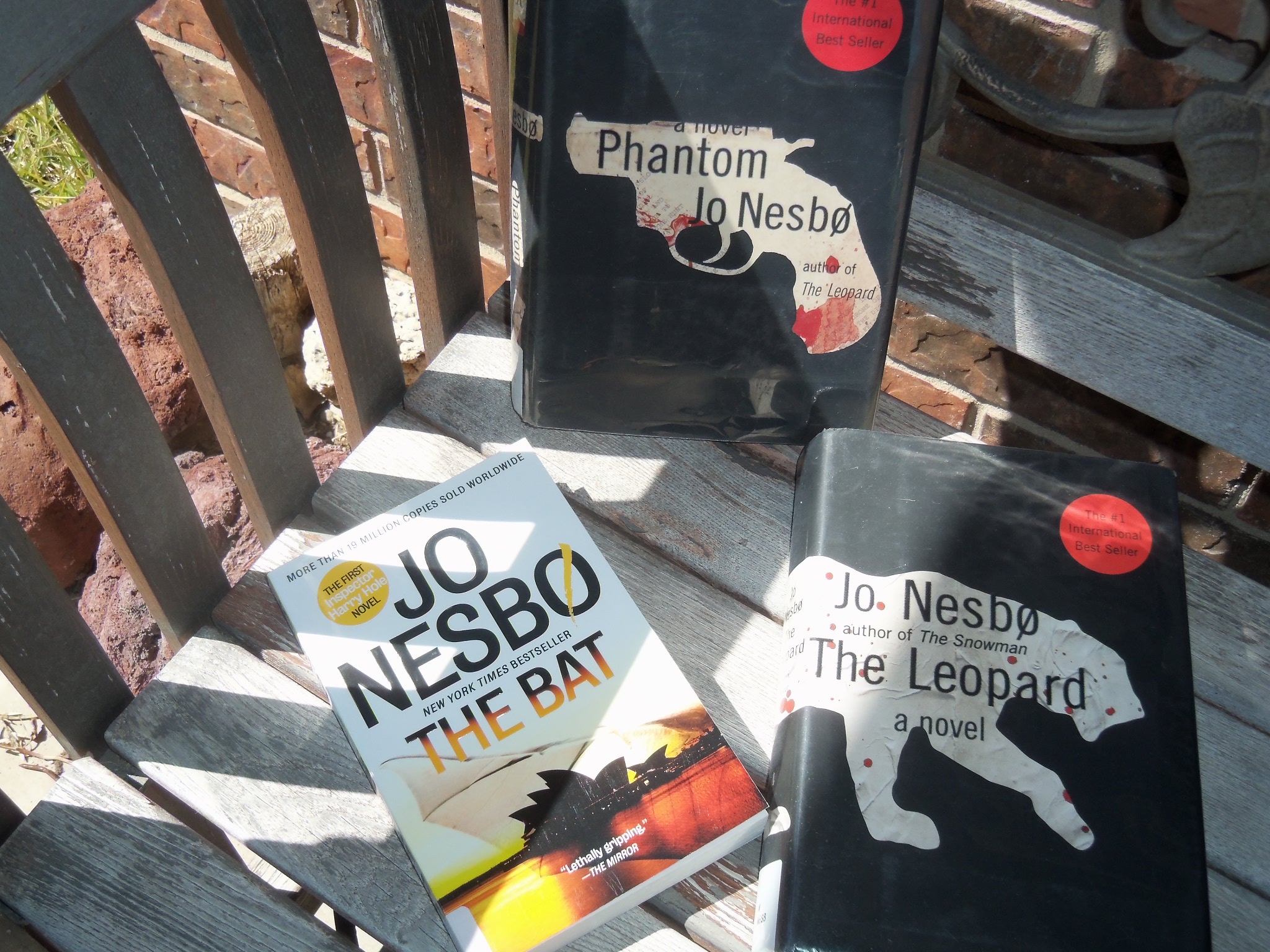
 Yes, Don Bartlett, a denizen of the UK who has obviously been everywhere, examined everyone in every language, taught everyone, and translated everything. He translated all ten of Norwegian crime fiction writer Jo Nesbø’s Harry Hole novels into English. How does a British non-native Norwegian speaker manage to show me the tortured people of Oslo, which seems to be rife with serial killers, damaged detectives, and messed up relationships? He puts me inside the head of a crooked detective known as “Beavis” from boyhood because he has an under bite and a horrible laugh like the cartoon character. Or Harry, who is lovable, horrible, crazy, brilliant, funny, and out of control. The novels are scary, sometimes grisly, funny, and full of wry observations about Norwegian culture.

So, how much is Don Bartlett and how much is Jo Nesbø?

I don’t read Norwegian, so how do I know that whatever I read on the page is what Jo Nesbø means to say?

Is the translated crime novel a baby being ushered into daylight by a midwife translator, or is the translator more of a surrogate parent than a mere midwife?

I don’t know the answer. I just know I love these books. Maybe it’s magic.

http://en.wikipedia.org/wiki/Jo_Nesb%C3%B8