Mystery/Thriller Recommendations

It’s that time of year! A time for reflection on the past year and anticipation of the new. If you’re like me, you hear a lot of people mention a good book or movie and you think to yourself, “That sounds good! I gotta remember that.” And then you don’t.

So, since I have a lot of friends on Facebook who like mysteries and thrillers, I’ve asked them to recommend at least one good book or movie they discovered this year. And of course, each of us here at AMW has a recommendation too.

Here they are, in no particular order:

1. Mandy Eve Barnett (author): mandyevebarnett.com – Lucy – it is unusual, exciting and a great twist at the end! A woman, accidentally caught in a dark deal, turns the tables on her captors and transforms into a merciless warrior evolved beyond human logic.

2. Beverly Nelms (personal and book club friend) – A Most Wanted Man with Philip Seymour Hoffman from a John LeCarre book. It’s about a (most likely) innocent Muslim man being ground up in the system by the Taliban, then by us. PSH plays a German operative with a small group of “assets” who is trying to help him. Underdogs helping the underdog. The view of agents, especially ours, is devastating.

3. Laura Wilson (personal and book club friend) – I liked The Girl with the Dragon Tattoo, book much better than the movie, by Stieg Larsson. The main character is a girl with a troubled background who is brilliant with technology and a research savant. There is torture, murder, blackmail and deceit all over this book.

4. Billy Kring (mystery author) www.billykring.com – Suspect by Robert Crais. One of my top reads of the year, and highly recommended. LAPD cop Scott James and his female partner are ambushed, and Scott is wounded, his partner killed. He is broken, suffering, and angry, textbook PTSD. As a last chance, he is partnered with a german shepherd with her own problems. Maggie is a two-tour bomb-sniffing dog who lost her handler in an ambush. She is also suffering from PTSD, and it is her last chance, too. When they begin to investigate the case where Scott’s partner was murdered, they have to rely on each other, and what they encounter in the case could well break both of them.

5. David B. Schlosser (writer, editor) – www.dbschlosser.com – The Broken Shore by Peter Temple. This terrific Australian mystery explores the traditional aspects of a crime/cop story — good guys, bad guys, and their travails — as well as some really interesting cultural challenges in Australia.

6. Kelly Pustejovsky (personal friend) – I watched Dream House yesterday on Netflix, surprisingly good.

7. Tara Madden (personal friend) – Wilde’s The Gods of Gotham and it’s sequel. Fairly new mystery series about the very beginnings of the NYPD set in the 1840s. Very good. Really pulls you into the story. Great richly created characters.

8. Jeanne Kisacky (writer) – It’s been out a while, but Elizabeth Wein’s Code Name Verity defied my ability to see where the plot was going. It was truly remarkable to read a book and not have any of my guesses pan out.

9. H.M. Bouwmann (author and professor) – www.hmbouwman.com – I’ll second the Code Name Verity recommendation. And I enjoyed both Robert Galbraith (Rowling) mysteries–though I loved the first more than the second. Also, just as an FYI, the opening couple of pages are not great. Then: very good.

10. Roger Cuevas (personal friend) – I love Alice LaPlant’s “Turn of Mind.” It’s narrated by a woman, a former hand surgeon with Alzheimer’s. Then one day her neighbor and long-time friend is found dead and the body’s hands have been expertly removed. Did she do it? Our narrator just can’t remember…

11. Morris Nelms (personal, book club friend, professor of fine arts, and musician) (Yea, he’s a cool guy) – The Afghan, by Forsyth. Frequencies, a sci-fi whodunit movie. Crescent City Rhapsody, a sci-fi thriller about what happens when an EMP disables everything.

12. Joseph Huerta (personal friend) – The two “Blood” books by James Rollins and Rebecca Cantrell that feature warfare against the forces of Armageddon, including angels and devils and a secret band of priests who were once vampires. Yes, it doesn’t really sound like a Joe-book but it was truly fascinating. The third book will be out this Spring.

13. Angie Kinsey (writer) – www.angiekinsey.com – The Martian by Andy Weir – a not too far fetched sci-fi thriller about an engineer who gets stranded on Mars. He has to figure out how to stay alive with the resources he has until he can connect with home. Entertaining and thrilling!

14. Debbie Woodard (personal friend) –  I discovered the BBC’S Sherlock this year. Fantastic production, great actors, character-driven-well-written scripts.

15. Elizabeth Buhmann (AMW member) – I’ve read a lot of good mysteries this year. I think I’ll go for Present Darkness, the latest by Malla Nunn, but my recommendation is not to start here but to start with her first, A Beautiful Place to Die. The setting for these books is South Africa in the 1950s, at the height of the Apartheid era.

16. Laura Oles (AMW member) – My favorite this year isn’t a traditional mystery but I loved it because it had a strong mystery component and very strong storytelling. It was Leaving Time by Judy Picoult.

17. Gale Albright (AMW member) – I was fascinated and awed by Tana French’s In the Woods, from the very first paragraph because her writing is lyrical and compelling. It’s set in Ireland and is her first book about the “Dublin Murder Squad.”

18. Kaye George (AMW member) – I’m JUST like that. I vow to remember the good books I’ve read, but, alas, my memory doesn’t really go back 12 months. I know that every Harlan Coben I read is my favorite. Recently I read “Iron Lake” by William Kent Krueger and it was terrific. It’s the first Cork O’Connor book. I’ve read others, but had never read this one.

19. Kathy Waller (AMW member) – Terry Shames’ A Killing at Cotton Hill. She captures small town life in a southern town while mixing humor with suspense and mystery. I couldn’t put it down. It won the 2014 Macavity Award. 

20. My favorite book that I read this past year was Jackaby by William Ritter. I loved the mix of historical fantasy and mystery. Jackaby is an investigator of unexplained phenomena and the story is told from the POV of his new assistant, Abigail Rook. It’s a bit like Sherlock Holmes meets Harry Potter. It was delightful and intriguing.

So there you have it! A whole slew of books to add to your TBR (To Be Read) list.

Etiquette for Critique Groups

We all know the importance of getting feedback from other writers, not just from friends and family. For many writers, that feedback comes from a critique group.

photo (16)Last summer, Sisters in Crime  hosted a meeting about etiquette for critique groups with special guest Tim Green, from St. Edwards University. Members of several local critique groups joined the discussion. The following guidelines and suggestions emerged.

Professor Green offered a general framework for face-to-face critiques. First the writer speaks, then readers take turns offering their comments. Finally, the whole group can engage in a general discussion, summarizing what they agree about and answering each other’s questions.

DOs:

  • The writer can introduce her work briefly, explaining what she’s trying to accomplish, whether her draft is rough or finished, and what kind of feedback she wants.
  • Readers should begin with the strengths of the piece (‘What works for me is…’) and move to questions and weaknesses (‘What doesn’t work for me,’ or ‘What I don’t understand is…’) afterwards.
  • Readers should speak to the writing, not the writer, pinning comments to specific passages in the text. This bears repeating! Find the specific words that trigger your reactions.
  • During the readers’ comments, the writer should remain silent, listen carefully, and save questions or explanations for the general discussion period.
  • Everyone should bear in mind that personal preferences are not aesthetic absolutes. Readers are only offering their subjective reactions and opinions. Writers should remember that, too.

DON’Ts:

  • Writers should resist the urge to disparage or apologize for their own writing.
  • Readers should resist the urge to rewrite or copyedit during group critiques.
  • Writers should try not to become defensive.

Professor Green advised that higher order concerns (plot, structure, character, voice, point of view, telling/showing) are appropriate for early drafts. Lower order concerns (dialogue, scene/setting, word choice, sentence management) are more likely to be useful for advanced drafts.

Most critique groups eventually settle on a routine that works for them, but for planning purposes, you could consider the following guidelines:

  • Four to six people is a good size for a critique group.
  • Ten pages is a reasonable length for submissions.
  • One or two minutes should suffice for the writer’s introductory remarks.
  • Allow about five minutes for each reader’s comments.

At this rate, you would expect to spend a half-hour or more on each submission. If everyone submits every time, you might need to allow as much as three hours for your sessions. Timekeeping can help ensure that each writer gets her fair share of attention.

Depending on where you live and what you write, you may have a hard time finding a local group that works in your genre or niche and meets at a convenient time and place. In that case, you could consider joining Authonomy, a website run by Harper Collins where thousands of authors post their work and exchange critiques online.

Elizabeth Buhmann

Elizabeth Buhmann is author of Lay Death at Her Door (Red Adept Publishing, May 2013)

Everyone agreed on the importance of keeping the comments positive. Praise for what works should come first to balance criticism. It may be necessary to curb or even remove a person who dominates discussion or persists in harsh criticism.

As writers, we learn and improve from criticism, but praise is the oxygen we breathe. Your critique group should not leave you feeling discouraged. If it does, drop out.

You should run home from your critique group sessions eager to reread the comments on your work and inspired to make the revisions that will take it to the next level.

A Christmas Pomodori

River Bluff Writers' Retreat 020Star Date: December 13, 2014

It all started with a weekend retreat. Don’t mysteries always start  like that? (Well, some of them.)

It’s like the beginning of a typical forties noir film. Think of a battered private dick, his face wrapped in bandages, trapped in a blindingly bright spotlight at the Hollywood police station. All in black and white with lots of shadows. The police want to know about a murder. When he starts talking, the scene dissolves into a flashback.

Except in my case, everything was in color, in the twenty-first century, and by the San Marcos River in Central Texas–not Hollywood.

What on earth are you talking about? I hear someone mutter. Why, I’m flashing back to how I wrote my fast-paced, hard-pulsing, heart-stopping crime melodrama, Holly Through the Heart, a live radio play done in person for an enthusiastic (I hope) audience (captive) of Sisters in Crime: Heart of Texas members.

I had come up with a daring (hare-brained) scheme in September. Why not have an old-fashioned live radio murder mystery play for our Christmas party on December 14? Then I proceeded to ask (beg, cajole) people to be in the cast. I had everything set up. But there was just a tiny, wee problem.

I was having trouble with the play itself. As in, writing it. There were three lovely paragraphs, almost a whole first page done. It was very promising. But I was stuck.

To myself, I said, “Self, you have asked all these folks to be in your play, and we are going to have to rehearse before the show debuts on December 14, so what are you going to do?”

Then fellow AMW critique partner Kathy Waller said we should have a writing retreat the first weekend in October, so we did, at a cabin on the San Marcos River. The cabin was lovely and rustic, surrounded by giant pecan trees and nestled in rural obscurity—except for the eleventy-million trucks hauling monster barbecue smokers in and out of the property next door. There was a barbecue cooking contest being held in close proximity to our cabin on Friday and Saturday. I thought there would be lots of noise and craziness going on next door, but perhaps we might be invited over to partake of delicious delicacies.

But no. There was no offer of succulent meat, but the noise level was kept to a decorous level down by the river. So I couldn’t use loud music and barbecue overdose to excuse my almost nonexistent radio play.

What did I do, you might ask. On Friday night, we went to the Sac ’n Pac on the highway and purchased delicious burgers for our supper. Then we sat around and talked and talked and talked and finally went to sleep.

On Saturday, some troublemaker brought up the fact that we were technically on a writing retreat and that maybe we should write. If I remember correctly, fellow AMW critique partner Valerie Chandler said we should use the Pomodoro technique to write something. We limbered up our laptops and did the Pomodoro. What is the Pomodoro, you may ask? Here’s the word from Wikipedia:

“The Pomodoro Technique is a time management method developed by Francesco Cirillo in the late 1980s. The technique uses a timer to break down work into intervals traditionally 25 minutes in length, separated by short breaks. These intervals are known as “pomodori”, the plural of the Italian word pomodoro for “tomato.” The method is based on the idea that frequent breaks can improve mental agility.” Taken from http://en.wikipedia.org/wiki/Pomodoro_Technique

I knew I was not motivated. But I sat there, hands poised over the keyboard, the timer went off, and I pounded away for twenty-five minutes. Took a break and then pounded for another twenty-five minutes.

And guess what?

I wrote the whole script.

That Saturday night, after we had gone back to the Sac ’n Pac to get pizza for dinner, we sat around and talked and talked and talked some more. One of the subjects we covered was my anguish over my current book plot. It needed help. So we all brainstormed, lying on couches, eating Goldfish (the baked cheese kind) and cookies and solved my plot problem.

That’s my story, coppers, and no matter how much you grill me, I won’t change my tune. That’s how it all went down.

So now, as I write this blog post on the evening of December 13, waiting for my pot roast to get almost done before I put in the potatoes (battered private dicks sometimes cook), and anticipating putting on the play tomorrow at 2 p.m. at the Book Spot in Round Rock, I think it’s going to be great.

We’ve rehearsed, given feedback, and worked on sound effects. I’ve had directorial angst, but I feel good about the whole thing.

Kudos to Kathy for setting up the writing retreat and for Valerie’s and Kathy’s help with Pomodoro sprints and book plot brainstorming.

Tomorrow Holly Through the Heart has its debut performance far from Broadway, at the Book Spot in Round Rock, Texas. But the journey begins with a single Pomodori, does it not?

I only wish, Valerie, that you had not gotten me addicted to Goldfish, but then artists must suffer, I suppose.

Star Date: December 14, 2014

Book Spot Dec. 14 SINC 028

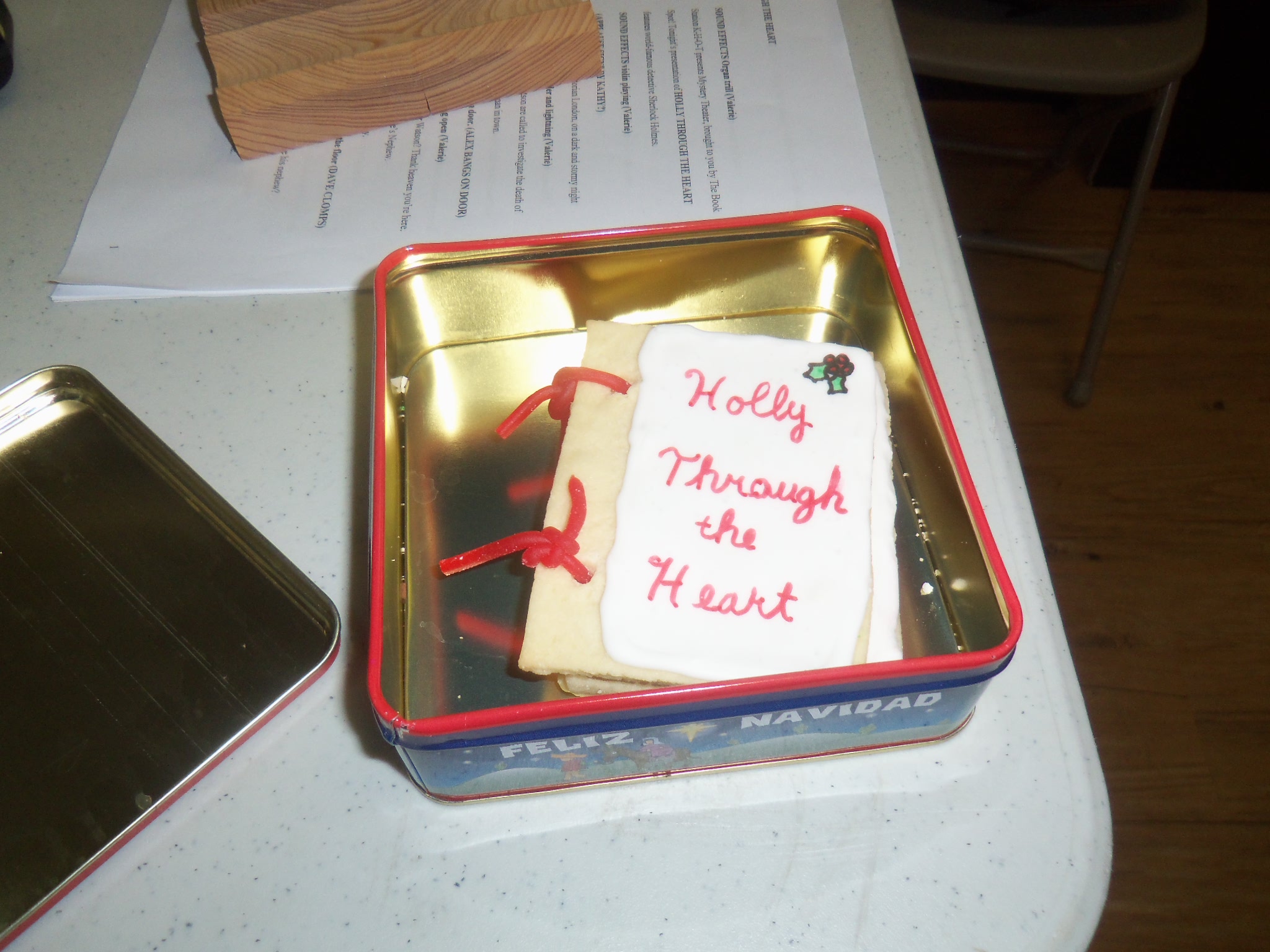
From left to right: Alex Ferraro, Kathy Waller, David Ciambrone, Gale Albright, and Valerie Chandler, cast of Holly Through the Heart, an old-time radio mystery drama performed live at its debut at the Book Spot on December 14, in Round Rock, TexasBook Spot Dec. 14 SINC 030A  cookie script of Holly Through the Heart, created by culinary genius Valerie Chandler.

By Gale Albright

Serial’s Strange Embrace: A 15-Year-Old Murder Mystery Captivates Millions

Have you been listening to Serial? Each week, millions of people anticipate the next episode of Serial, a podcast-turned-obsession produced by This American Life (TAL), which covers the investigation of a 15-year-old murder case. Serial has done a masterful job of pulling people into a real-life murder mystery, and I am one of those waiting for a new episode each Thursday. serial_logo

Serial is hosted by Sarah Koenig, a journalist and  executive producer working for TAL, who spent a year studying the case of Hae Min Lee, a well-liked Baltimore high school student who was murdered in 1999 at the age of eighteen. Lee’s body was discovered six weeks after she was murdered, buried in a shallow grave in Leakin Park (often pronounced as Linkin Park). Leakin Park has a reputation as a hiding place for the dead. It has been said, “If you’re going to bury a body in Leakin Park, you’re going to find someone else’s.”   It is no place for anyone’s child.

Detectives investigated Hae Min Lee’s murder and her ex-boyfriend, Adnan Syed, found himself at the center of the inquiry. Before long, Adnan Syed, was tried, convicted and sentenced to life in prison. Many believe he was wrongly convicted while others say justice has been served.

The question remains, “Did Adnan Syed kill Hae Min Lee?”

Sarah Koenig’s storytelling skills are impressive and on full display each week. Her recorded telephone conversations with Adnan Syed from prison, as well as interviews with his friends and others who knew him, bring us close to the investigation. Koenig’s analysis helps us realize that she isn’t sure about the truth, either. Each week moves us back and forth on the pendulum swing between guilt and reasonable doubt, even innocence. Each week’s episode has caused controversy, discussion and a broader conversation regarding what should be used to prosecute capital murder cases.

Serial includes a number of discoveries and twists, which I won’t spoil in this post. For those of us who are interested in studying skilled storytelling, consider enrolling in Koenig’s class by listening to this podcast. While many have proclaimed podcasts a medium with little growth potential, Serial has proven otherwise. QuestionsKoenig is clear that she isn’t too far ahead of us in her weekly recordings. They didn’t have the entire season ‘in the can’ before Episode 1 aired, and we can feel the uncertainty as she discusses the case with experts and others involved, including a juror who served on Adnan Syed’s trial.

Koenig reads from Hae Min Lee’s diary and re-traces routes and timelines testified to in court. In her hands, the story unfolds in such a way that even some who feel they know the case are surprised by what she finds. The one thing that has stayed with me throughout my listening journey, apart from the horrific reality that a young woman was murdered and her family forever damaged by living with unfair reality, is that the way in which Adnan Syed was convicted. While I haven’t read the court transcripts, what we have learned so far is concerning. Did Syed commit the crime? Was the evidence used to convict him sufficient?  The issue is being hotly debated at water coolers and cafes across the country.

And with good reason.

Serial achieves a quality of storytelling rarely found in the true crime genre, and the result is a podcast that has broken iTunes records, becoming the fastest downloaded podcast to reach 5 million listeners. It’s a nod to old-style crime radio but with the contemporary twist. Its success has brought new attention to the case as well as some backlash criticism that a murder case should not be used for the public’s entertainment. These are curious waters to navigate but the exploration of true crime stories has been an industry for some time. Serial has simply found a way to connect with listeners in a compelling manner. As mystery writers, while we may be inspired by certain events, our work is fiction. No people or animals are harmed in the process of creating our stories. However, in Serial’s world, we are listening to an investigation involving real lives and real suffering, a viscerally violent foundation upon which this new American obsession rests.

The victim, Hae Min Lee, as reported by friends, was smart, funny and full of promise. She left this world far too soon and the space she has left open in her family’s hearts will never be filled. Yes, Serial is compelling, in large part, because of the real lives affected, because the stakes are high, because so much mystery remains in this case. Let us remember those people at the center of this reality. They are not characters–they are real people carrying this burden, long after each episode has ended.

To learn more about Serial, visit www.serialpodcast.org

Serial logo property of This American Life.

–Laura Oles